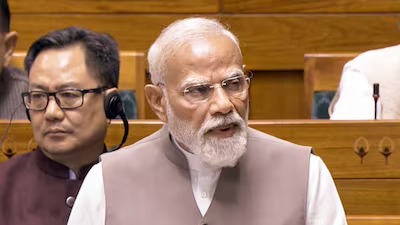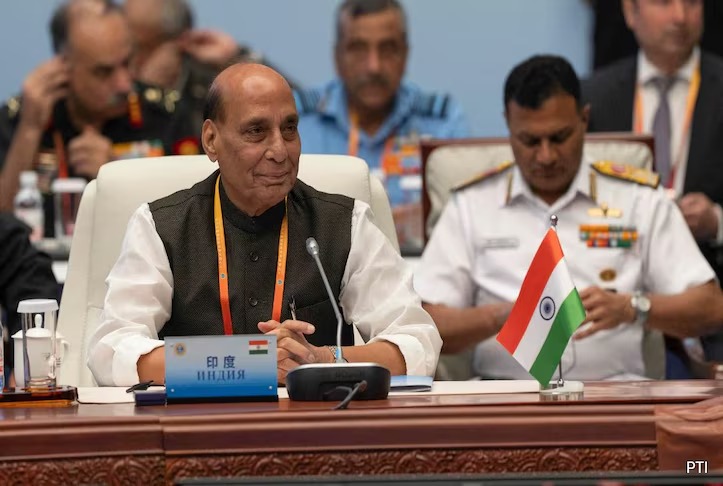
New Delhi: Defence Minister Rajnath Singh delivered a firm message on terrorism and regional security during the Shanghai Cooperation Organisation (SCO) Defence Ministers’ Meeting in Qingdao, China, subtly calling out Pakistan without naming it. Speaking in the backdrop of the recent Pahalgam terror attack, Singh underscored the need for SCO members to adopt a consistent and uncompromising stance against terrorism.
Addressing defence leaders from the ten full member states of the SCO, Singh said, “Peace, security, and trust deficit remain the biggest challenges in our region. Some countries use cross-border terrorism as an instrument of state policy and provide shelter to terrorists. There should be no place for such double standards. The SCO should not hesitate to criticise such nations.”
His remarks come just weeks after the April 22 terror attack in Pahalgam, Jammu and Kashmir, in which 26 civilians — including a Nepali national and a local pony handler — were killed in a brutal assault carried out by The Resistance Front (TRF), a proxy of the UN-designated terror outfit Lashkar-e-Taiba (LeT). Victims, Singh noted, were reportedly profiled and shot based on their religious identity.
“On April 22, 2025, the terror group ‘The Resistance Front’ carried out a heinous attack on innocent tourists at Pahalgam in Jammu and Kashmir. Twenty-six innocent lives were lost. The attack was not random — the victims were deliberately targeted after religious profiling. TRF, a known proxy of Lashkar-e-Taiba, claimed responsibility for this barbaric act,” Singh stated.
The two-day SCO Defence Ministers’ meet, hosted under China’s 2025 Chairmanship in Qingdao, focused on enhancing regional cooperation under the theme: “Upholding the Shanghai Spirit: SCO on the Move.” The event gathered defence ministers and top officials from SCO member countries including China, Russia, Pakistan, India, Kazakhstan, Kyrgyzstan, Tajikistan, Uzbekistan, Iran, and newly joined Belarus.
In his address, Singh also stressed the importance of reformed multilateralism and collaborative security frameworks to tackle emerging challenges in a multipolar world. “India believes that reformed multilateralism can foster cooperation and prevent conflict by enabling dialogue and collective action. No nation, no matter how powerful, can single-handedly tackle all the challenges of today’s interconnected world,” he added.
The Defence Minister also highlighted India’s principled approach to international security and its commitment to zero tolerance for terrorism. He reiterated that nations that continue to support or turn a blind eye to terrorism should be held accountable.
In addition to the multilateral discussions, Singh is scheduled to hold bilateral meetings with his counterparts from Russia and China. Key issues on the agenda include border security, enhanced defence cooperation, and mechanisms for joint counter-terrorism efforts.
India’s participation in the summit, while marked by diplomatic caution, reaffirmed its clear stand against terrorism in all forms and called for greater accountability and unity within regional groupings like the SCO. Singh’s speech was a subtle yet unmistakable reminder that the success of multilateral platforms depends on sincerity and the courage to call out duplicity—especially when it threatens peace and civilian lives.
Sorry, there was a YouTube error.