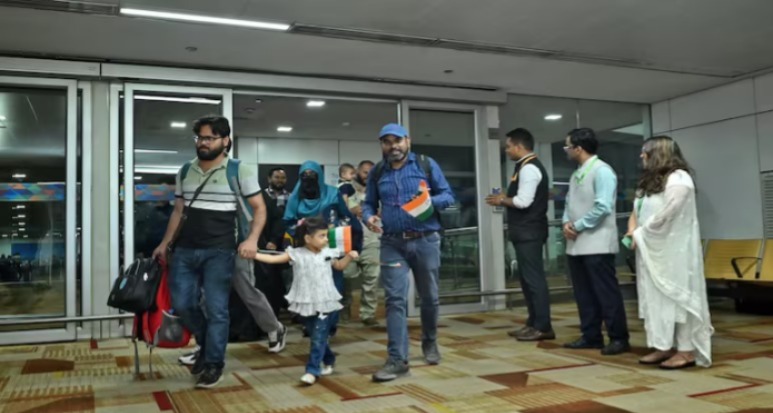
New Delhi: Amid rising tensions in West Asia, the Government of India has launched Operation Sindhu to safely evacuate Indian nationals stranded in conflict-hit regions of Iran and Israel. The massive effort, coordinated by the Ministry of External Affairs (MEA), has successfully brought back 4,415 individuals so far through 19 special evacuation flights, including three Indian Air Force (IAF) C-17 aircraft.
The operation began on June 18, with the Indian Missions in Tehran, Yerevan, and Ashgabat working in coordination to move citizens across land borders into Armenia and Turkmenistan, where flights to India were arranged. Iran formally opened its airspace for evacuation operations at India’s request on June 20, allowing for smoother coordination from Mashhad, a major evacuation hub.
According to MEA, 3,597 Indians were evacuated from Iran, while 818 were rescued from Israel. Among those evacuated were students, professionals, pilgrims, workers, fishermen, and others from over 15 Indian states. Notably, the evacuees included over 1,500 women and 500 children. Additionally, 14 OCI (Overseas Citizen of India) card-holders, 9 Nepalese, 4 Sri Lankan nationals, and 1 Iranian spouse of an Indian national were also airlifted from Iran.
The Israel leg of the evacuation began on June 23, with Indian Missions in Tel Aviv, Ramallah, Amman, and Cairo facilitating safe passage across land borders into Jordan and Egypt. Between June 22 and 25, a total of 818 Indians were flown back from Amman and Sharm el-Sheikh, including via the IAF’s heavy-lift aircraft.
The MEA announced that evacuation operations were temporarily halted on June 25 following the reopening of airspace in the affected regions. However, it emphasized that further actions would depend on how the security situation in West Asia evolves.
“Operation Sindhu is a reflection of India’s unwavering commitment to the safety and well-being of its citizens abroad,” said the MEA, highlighting the personal oversight of the mission by Prime Minister Narendra Modi.
The Government also extended its gratitude to the administrations of Iran, Israel, Jordan, Egypt, Armenia, and Turkmenistan for their cooperation and support during the evacuation process. The MEA assured that Indian Missions would continue to remain in close contact with host countries and Indian communities across the region.
As geopolitical uncertainty continues in the region, Operation Sindhu stands as yet another example of India’s ability to execute large-scale humanitarian operations with speed, efficiency, and international coordination.
Sorry, there was a YouTube error.