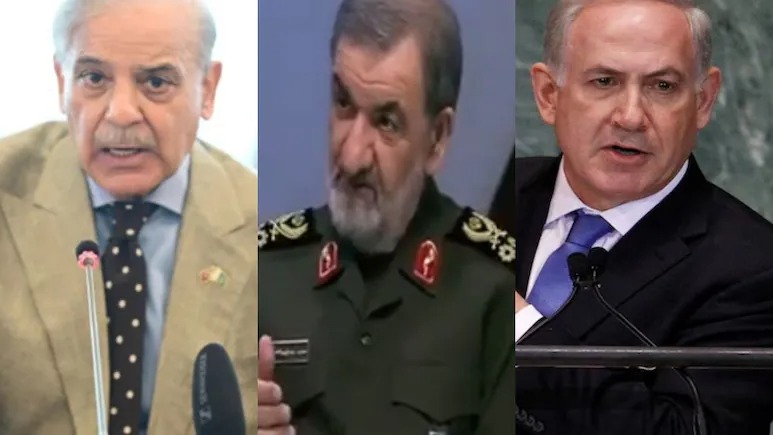
Tehran: In a dramatic escalation of rhetoric amid ongoing conflict in the Middle East, a top Iranian military official has claimed that Pakistan has pledged to launch a nuclear strike against Israel if the latter uses a nuclear weapon on Iran. The statement was made by General Mohsen Rezaei, a senior commander in Iran’s elite Islamic Revolutionary Guard Corps (IRGC) and member of the country’s National Security Council, during a broadcast on Iranian state television.
Rezaei’s remarks came as tensions between Iran and Israel continue to spiral, with both countries reportedly exchanging heavy missile fire. According to official sources, the death toll from the latest flare-up stands at 248—230 in Iran and 18 in Israel.
“Pakistan has assured us that if Israel uses a nuclear bomb on Iran, they will attack Israel with a nuclear bomb,” Rezaei declared in the interview. He also asserted that Iran possesses “hidden capabilities” that the world is yet to see, suggesting Iran’s preparedness to respond to any potential escalation.
While no official confirmation or denial has been issued by Islamabad, Rezaei claimed that Pakistan has vowed to “stand behind Iran” and urged the Muslim world to unite in opposition to Israeli aggression. The statement comes amid a backdrop of warming ties between Tehran and Islamabad, following their own missile exchange earlier in 2024 which was quickly de-escalated.
Israel and Pakistan are two of the nine nations recognized by the International Campaign to Abolish Nuclear Weapons (ICAN) as nuclear-armed states. While Pakistan has long held a policy of minimum credible deterrence, it has never officially recognized Israel or engaged in formal diplomatic relations.
Rezaei’s assertion appears to signal a broader diplomatic alignment rather than a confirmed military pact, but its implications have alarmed geopolitical observers. Analysts note that such declarations, even if not backed by formal agreements, could further destabilize an already volatile region.
In the midst of the escalating crisis, the United States has attempted to mediate, although it has so far refrained from direct military involvement. Former President Donald Trump, who returned to office earlier this year, issued one of his sternest warnings to Tehran. “If Iran attacks the US, the full strength and might of the US Armed Forces will come down on you at levels never seen before,” Trump stated, highlighting Washington’s commitment to defending its interests and allies in the region.
Meanwhile, Pakistani Defence Minister Khwaja Asif voiced concerns about Israel’s nuclear capabilities, stating that the Western world needs to address the root causes of the growing regional instability. “Conflicts being generated by Israel will engulf the entire region and beyond. Their patronage of Israel is a dangerous game,” he said, further cementing Islamabad’s diplomatic posture in support of Iran.
As global powers watch the Middle East crisis unfold, the latest claims from Tehran have sparked renewed fears of a nuclear flashpoint. While diplomatic channels remain open, the prospect of a wider regional war—especially one involving nuclear-armed states—has never felt more real.
Sorry, there was a YouTube error.