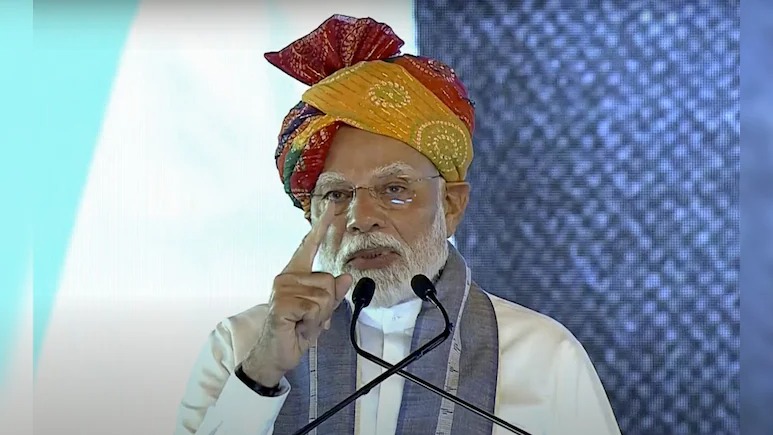
New Delhi: In a recent address at the inauguration of Hisar airport in Haryana, Prime Minister Narendra Modi launched a sharp critique of the Congress party’s stance on the Waqf (Amendment) Act. He questioned the party’s commitment to truly representing Muslim interests, suggesting that their opposition to the law was evidence of continued appeasement politics. The event also highlighted Prime Minister Modi’s reverence for Dr. BR Ambedkar, whose birthday was commemorated that day, and whose principles Modi claimed guide his government’s policies.
Modi’s remarks targeted the Congress for alleged favoritism towards Muslim fundamentalists while neglecting broader Muslim welfare. He posed a provocative question: Why has the Congress never appointed a Muslim as its party president or reserved a significant number of election tickets for Muslim candidates? This, according to Modi, reflects the party’s exploited “vote-bank politics,” which fosters dependency rather than genuine empowerment.
The Prime Minister criticized the Congress for historically manipulating the Constitution to maintain power. He noted instances where the Constitution’s secular principles, such as a uniform civil code, were disregarded. Specifically, he pointed out that while a uniform civil code has been implemented in Uttarakhand, the Congress opposes it. Moreover, Modi claimed that the Waqf law amendments were necessary to counteract earlier changes made by the Congress, which allegedly benefited land mafias over the broader Muslim community. Under the new law, Modi assured that tribal lands would be protected and the rights of poor and Pasmanda Muslims safeguarded.
In response, Congress president Mallikarjun Kharge accused the Modi government of not adhering to Ambedkar’s vision. Kharge argued that while the government speaks negatively about the Congress and its historical figures, it fails to enact meaningful reforms like Ambedkar would have wanted. He emphasized the Congress’s long-term commitment to securing reservations for SC, ST, and OBC women within the Women’s Reservation Bill.
Sorry, there was a YouTube error.