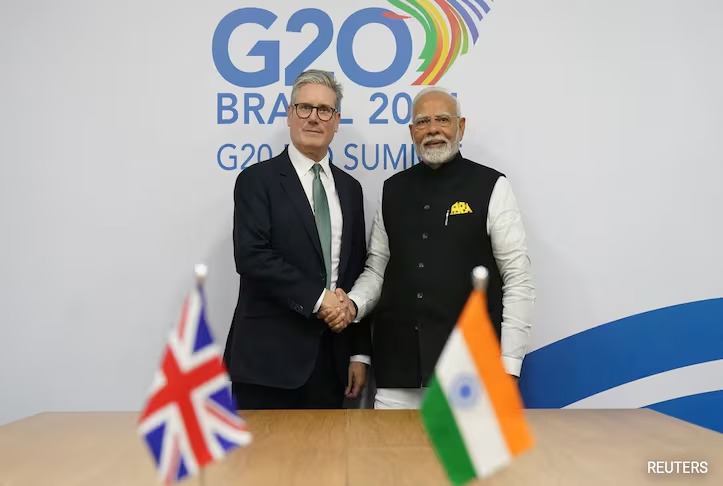
LONDON: Prime Minister Narendra Modi arrived in the UK today for his fourth visit since taking office, where he is expected to seal a landmark India-UK Free Trade Agreement (FTA) with British Prime Minister Keir Starmer. The long-awaited deal, the first major bilateral trade agreement India is signing with a developed country in over a decade, is aimed at doubling bilateral trade to $120 billion by 2030.
Here are the key highlights of the agreement and its broader impact:
The FTA, formally titled the Comprehensive Economic and Trade Agreement, will be signed in London in the presence of PM Modi and Commerce Minister Piyush Goyal, who is accompanying him. Negotiations, which began in 2021, concluded earlier this year on May 6 after 14 rounds of talks.
The deal significantly reduces or eliminates tariffs, offering 99% of Indian exports duty-free access to the UK market. This includes labour-intensive goods such as leather, footwear, textiles like Banarasi and Chanderi sarees, and handmade Kolhapuri chappals—many of which are produced by women artisans. In return, India will lower tariffs on key UK exports like whisky and automobiles.
This pact is being seen as a gender-inclusive breakthrough, with dedicated provisions on labour rights, anti-corruption, gender equality, and development—a first in India’s trade policy. These chapters are expected to empower women entrepreneurs, increase job creation, and support women-led businesses.
To bolster transparency and facilitate easier business operations, a double social security contribution exemption has also been signed. This will allow Indian professionals working in the UK to avoid dual social security payments.
In 2024–25, India’s exports to the UK rose by 12.6% to $14.5 billion, while imports from the UK were $8.6 billion, marking a steady growth. The overall bilateral trade reached $21.34 billion in 2023–24, up from $20.36 billion the previous year. The UK is currently India’s sixth-largest investor, with investments worth around $36 billion and over 1,000 Indian companies employing 1 lakh people in Britain.
The agreement is also expected to safeguard India’s cultural identity in global trade. Following recent controversies, such as Prada’s unauthorized use of Kolhapuri designs, the deal seeks to curb cultural appropriation by enhancing “Brand India” protections.
While the Indian Cabinet has approved the deal, it will require ratification by the British Parliament before implementation.
Following the London visit, PM Modi will travel to the Maldives at the invitation of President Mohamed Muizzu, signaling a potential thaw in recently strained bilateral ties.
This FTA marks a new era in India-UK relations, blending economic ambition with cultural preservation and gender equity.
Sorry, there was a YouTube error.