Team Goemkarponn
PANAJI: Government has been ordered to act immediately against companies that pollute the River Sal and Salpem Lake in Navelim by the Bombay High Court (HC) in Goa.
The Deputy Collector of South Goa and the Salcete Mamlatdar have been directed by the court to promptly implement the Goa State Pollution Control Board’s (GSPCB) orders and close down establishments that are in violation of environmental standards.
Additionally, the Margao Municipal Council (MMC), which had previously disregarded its closure orders, has been directed to carry them out.
Amicus Curiae Neha Shirodkar, who was appointed in response to a Public Interest Litigation (PIL) filed by Professor Antonio Alvares, a resident of Navelim, filed the report that prompted the intervention.
Based on a thorough examination of Margao’s waterways and drainage systems, the research emphasizes the widespread sewage discharge into stormwater nullahs and watercourses that lead to Salpem Lake.
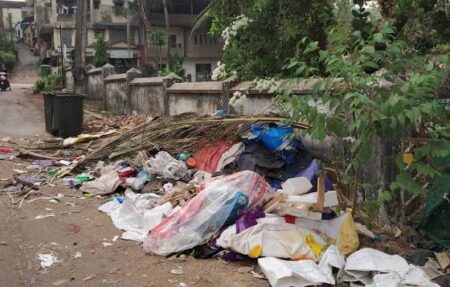
Despite previous warnings and fines, numerous enterprises are still releasing garbage into public water systems, according to photographic evidence.
In order to stop more infractions, the Amicus Curiae asked the court to order authorities to carry out surprise inspections. Furthermore, it was requested that the South Goa Planning and Development Authority (SGPDA) immediately establish temporary plans for the appropriate disposal of sewage at its retail market. The HC stated that market activities should be halted until appropriate measures are put in place if the SGPDA does not comply within 10 days.
The HC ordered the Sewage Infrastructure Development Corporation of Goa Ltd (SIDCGL) to provide a status report on the development of a dedicated sewage connection that would connect the SGPDA retail fish market to the subterranean network within four weeks of the crisis.
There are still a lot of holes in the SGPDA market’s trash disposal infrastructure, despite some efforts. There is currently no infrastructure connecting the market to an underground sewage line, even though meat stall proprietors have received permission from the GSPCB to continue operating. Consequently, untreated sewage keeps entering stormwater drains, which eventually contaminates River Sal.