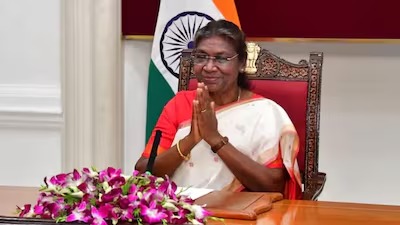
New Delhi: President Droupadi Murmu will administer the oath of office to the newly elected Vice President of India on September 12, as the electoral process reaches its conclusion. The election follows the sudden resignation of the previous Vice President, Jagdeep Dhankhar, and is set to be a direct contest between the ruling National Democratic Alliance (NDA) nominee C P Radhakrishnan and the joint opposition candidate B Sudershan Reddy.
Voting will commence at 10 AM and continue until 5 PM, with members of both Houses of Parliament eligible to cast their votes. The counting of ballots will begin soon after polling concludes, and the final result is expected to be announced by late evening.
The vice presidential election is being conducted by an electoral college comprising 788 members – 245 from the Rajya Sabha and 543 from the Lok Sabha. The 12 nominated members of the Rajya Sabha are also eligible to vote. However, with six Rajya Sabha seats and one Lok Sabha seat currently vacant, the effective strength stands at 781, making the majority mark 391.
The NDA holds 425 MPs, comfortably above the required threshold, while the opposition bloc has the support of 324 members. Among the unaffiliated parties, the YSR Congress Party (YSRCP) with 11 members has extended support to the NDA nominee, whereas the BRS and BJD have opted to abstain from voting.
C P Radhakrishnan, a seasoned BJP leader from Tamil Nadu and the current Governor of Maharashtra, represents the ruling alliance. His opponent, B Sudershan Reddy, is a former Supreme Court judge from Telangana, known for landmark rulings, including his verdict declaring the Salwa Judum campaign unconstitutional. The judgement sparked controversy, as the campaign had been aimed at countering Maoist insurgency in Chhattisgarh.
Home Minister Amit Shah criticized Reddy’s judgement, calling it a blow to anti-Maoist efforts, adding a political edge to an otherwise procedural election campaign.
As the nation awaits the outcome, the vice presidential election is being closely watched for its political and constitutional implications.