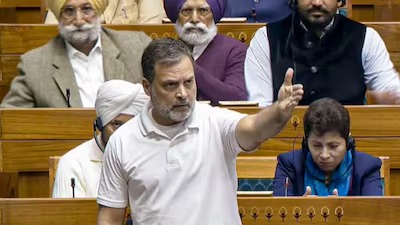
New Delhi: Senior Congress leader Priyanka Gandhi Vadra strongly opposed the Centre’s new Bill to replace the Mahatma Gandhi National Rural Employment Guarantee Act (MGNREGA) with the Viksit Bharat Rozgar and Ajeevika Mission (Gramin), also called the G Ram G Bill. Speaking in the Lok Sabha on Tuesday, the Wayanad MP argued that the Bill weakens the law, diminishes the role of Gram Sabhas, and shifts funding from a demand-based to a pre-determined normative model.
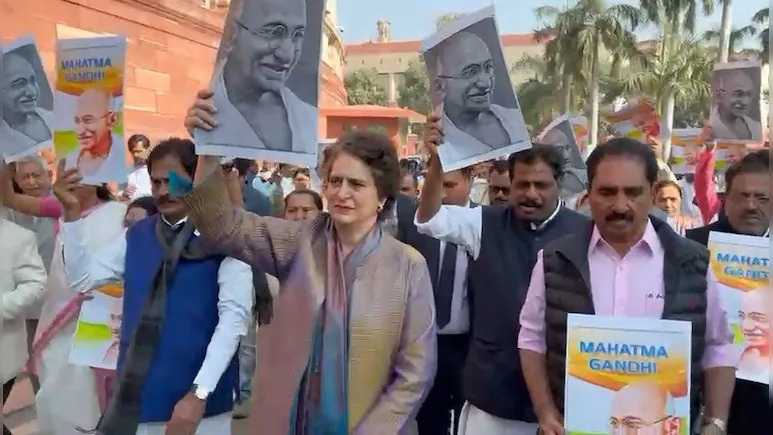
During a protest on Parliament premises, Congress lawmakers held up photographs of Mahatma Gandhi to signal their disapproval of removing his name from the rural employment scheme. Priyanka Gandhi called on the government not to pass laws based on “whim, ambition, or prejudice” and demanded that the Bill be withdrawn and reintroduced after proper discussion.
“MGNREGA has been successful in providing livelihood to rural India and strengthening the rural economy for 20 years. It guarantees 100 days of employment per year to the poorest of the poor. This is a revolutionary law, and every political party had supported it when it was introduced,” she said.
The new Bill changes the scheme’s funding structure, reducing the Centre’s share to 60 percent in most states while requiring states to bear 40 percent of costs. Priyanka Gandhi warned that this would strain state budgets, especially as many are still awaiting GST dues from the Centre. She also criticized the shift from demand-based allocations, which allow Gram Sabhas to assess work requirements locally, to normative funding determined centrally.
Responding to a remark from the treasury benches, Priyanka Gandhi said, “Mahatma Gandhi is not from my family, but he is like my family, and the entire country feels the same way.” Congress MP Shashi Tharoor echoed her criticism, describing it as “immoral” to remove Gandhi’s name.
Government sources defended the Bill, stating that the shift to normative funding aligns MGNREGA with the broader Viksit Bharat 2047 vision and with the budgeting model used for most central schemes. They argued that demand-based allocations can create unpredictable funding gaps, while normative funding ensures predictable planning without compromising employment guarantees.
BJP leaders, including former Minority Affairs Minister Mukhtar Abbas Naqvi, suggested that the opposition’s objections are primarily due to the inclusion of Lord Ram’s name in the new scheme.
Sorry, there was a YouTube error.