New Delhi:
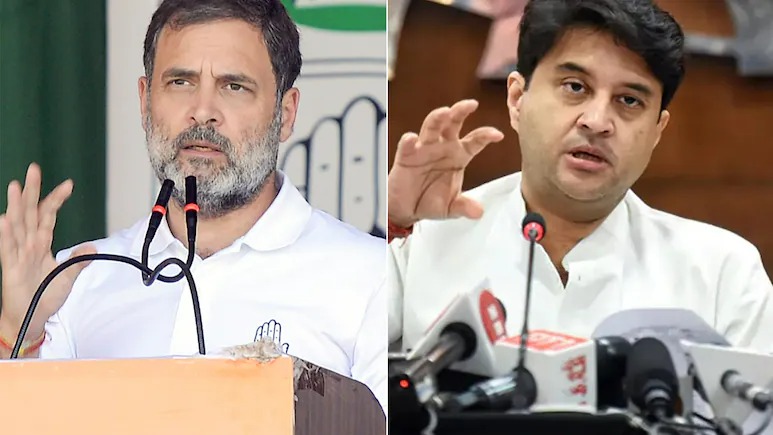
In a rally at Mhow, Madhya Pradesh, Congress leader Rahul Gandhi’s comments on the historical privileges of royal families have ignited a fierce controversy, drawing sharp criticism from Union Minister Jyotiraditya Scindia and BJP MP Dushyant Singh. Gandhi’s assertion that before India’s independence, only kings and maharajas held rights, while the poor, Dalits, and backward classes were marginalized, has reopened a historical debate on the roles of royal families in pre-independence India.
Gandhi’s remarks, made during the Jai Bapu, Jai Bhim, Jai Samvidhan rally, highlighted the stark contrast between the pre-independence era and the post-independence period, where he claimed that independence brought rights and land to the people. However, this narrative has been challenged by Scindia and Singh, who argue that Gandhi’s views demonstrate a narrow understanding of history.
Scindia, a member of the erstwhile royal family of Gwalior, countered Gandhi’s comments by emphasizing the significant contributions of royal families to social justice and education. He cited examples such as Baroda Maharaja Sayajirao Gaekwad’s financial support for Dr. B.R. Ambedkar’s education and Chhatrapati Shahuji Maharaj’s pioneering efforts in introducing 50% reservation for backward classes in governance in 1902. Additionally, Scindia mentioned Madhav Maharaj I of Gwalior’s initiatives in establishing education and employment centers for backward communities.
Dushyant Singh, a five-time MP and member of the Dholpur royal family, also weighed in, criticizing Gandhi’s “reckless ‘hit-and-run’ politics” and highlighting the Dholpur royals’ role in modernizing administration, building hospitals, and developing essential public infrastructure like roads and railways. Singh argued that these contributions were pivotal in shaping India’s progress toward equality and justice.
However, Congress leader Pawan Khera countered Scindia’s narrative, accusing him of whitewashing history. Khera pointed out that while some royal families made positive contributions, many others had ties with the British and engaged in actions detrimental to the nation. He mentioned that the Gwalior royal family received tax-free allowances from the Indian government until 1971 and that a royal family’s pistol was used in Mahatma Gandhi’s assassination. Khera also quoted Jawaharlal Nehru’s remarks from the Constituent Assembly, rejecting the concept of monarchy and divine right to rule.
The controversy has underscored the broader political tensions and historical interpretations in Indian politics. Both the Congress and BJP are accusing each other of misrepresenting history, with each side seeking to validate their own narrative. This debate highlights the complex and multifaceted nature of India’s journey toward democracy and social equality.
Sorry, there was a YouTube error.