Qingdao: On the sidelines of the Shanghai Cooperation Organisation (SCO) Defence Ministers’ Meeting in Qingdao, Defence Minister Rajnath Singh engaged in high-level bilateral discussions with his Chinese and Russian counterparts, underlining India’s commitment to regional stability and strategic partnerships.
In his meeting with Chinese Defence Minister Admiral Dong Jun, Rajnath Singh described the dialogue as “constructive and forward-looking,” as both leaders addressed key issues concerning bilateral relations. Singh stressed the importance of maintaining positive momentum in India-China ties and avoiding the creation of new complexities.
Taking to social media platform X, Singh wrote, “Held talks with Admiral Dong Jun, the Defence Minister of China, on the sidelines of the SCO Defence Ministers’ Meeting in Qingdao. We had a constructive and forward-looking exchange of views on issues pertaining to bilateral relations. Expressed my happiness on restarting of the Kailash Mansarovar Yatra after nearly six years.”
The Defence Minister emphasized the need for continued engagement and mutual understanding, particularly after a challenging phase in India-China relations. Singh’s visit marks the first major bilateral exchange at the defence level between the two countries following recent diplomatic efforts to stabilize ties.
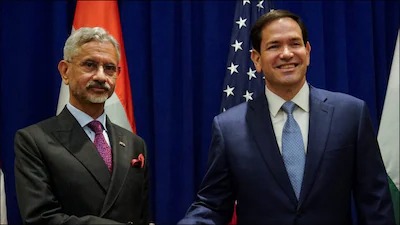
Singh was formally received by Admiral Dong Jun on his arrival and later joined other defence leaders for a group photograph ahead of the formal SCO session.
Singh’s meeting comes shortly after National Security Advisor Ajit Doval met Chinese Foreign Minister Wang Yi in Beijing on June 23. The two officials reviewed developments in bilateral relations and discussed a roadmap to deepen cooperation, especially through people-to-people engagement.
Doval underlined the importance of combating terrorism in all its forms to preserve peace and stability in the region. Both sides also explored regional and global developments of mutual concern.
MEA spokesperson Randhir Jaiswal shared on X, “NSA Ajit Doval met Chinese FM Wang Yi in Beijing today. Discussions focused on bilateral, regional & international issues of mutual interest.”
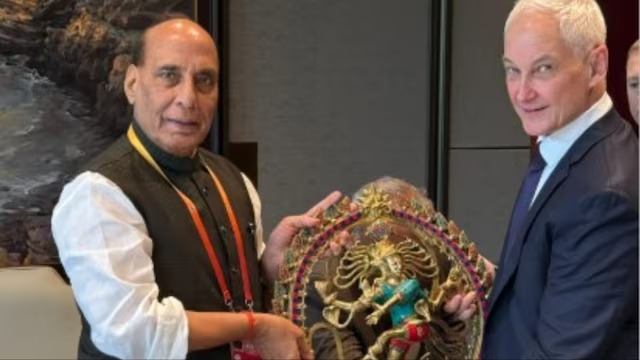
In another crucial bilateral, Rajnath Singh held extensive discussions with Russian Defence Minister Andrey Belousov, focusing on deepening India-Russia defence cooperation amid the evolving regional security landscape.
Describing the meeting as “insightful,” Singh stated, “Happy to have met the Defence Minister of Russia, Andrey Belousov, on the sidelines of the SCO Defence Ministers’ Meeting in Qingdao. We had insightful deliberations on boosting India-Russia defence ties.”
Among the topics discussed were the ongoing supply and operationalisation of the S-400 air defence missile systems, which played a critical role during India’s recent ‘Operation Sindoor’. The discussions also included timelines for Su-30 MKI upgrades and the expedited procurement of vital military hardware.
India has ordered five squadrons of the Russian S-400 system, with three already active. The remaining two are expected to be delivered by 2026.
The Russian minister reaffirmed Moscow’s long-standing defence partnership with New Delhi and expressed solidarity with India following the April 22 terror attack in Pahalgam, Jammu and Kashmir.
Another key highlight of the talks was the upcoming commissioning of the Indian Navy’s guided missile frigate INS Tamal in Kaliningrad, Russia, scheduled for July 1. The Russian-built frigate will be formally inducted in the presence of Vice Admiral Sanjay J Singh, Flag Officer Commanding-in-Chief of the Western Naval Command.
According to the Indian Defence Ministry, the Singh-Belousov meeting was among the most significant engagements in recent times, especially in the context of India’s heightened security posture post-Operation Sindoor.
The SCO, which includes India, China, Russia, Pakistan, Iran, Kazakhstan, Kyrgyzstan, Tajikistan, and Uzbekistan, continues to serve as a critical multilateral platform for dialogue on security and defence cooperation.
Rajnath Singh’s back-to-back bilateral meetings reflect India’s growing diplomatic and strategic engagements in the region as it seeks to balance strong traditional partnerships with emerging geopolitical realities.
Sorry, there was a YouTube error.