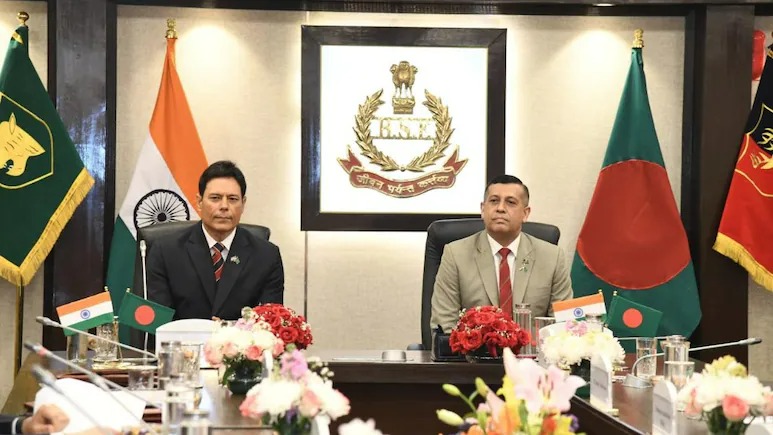
New Delhi:
In the aftermath of the regime change in Bangladesh last August, the Director General of the Border Guard Bangladesh (BGB), Maj Gen Mohammad Ashrafuzzaman Siddiqui, has downplayed reports of attacks on minority groups in his country. During a high-level meeting with Indian officials in New Delhi, Siddiqui asserted that these reports were exaggerated and attributed any clashes to political rather than sectarian tensions.
The meeting, the first of its kind since the change in government, saw Siddiqui and BSF Director General Daljit Singh Chawdhary discussing various border-related issues. Siddiqui emphasized that the law enforcement agencies in Bangladesh had ensured the safety of minorities, citing the peaceful celebration of Durga Puja by the Hindu community as evidence. “The Hindus in Bangladesh celebrated Durga Puja without any issues. The law enforcing agencies were tasked to ensure their safety,” he said.
Contrary to Siddiqui’s claims, a recent report by the UN Human Rights Office detailed widespread attacks on Hindu homes, businesses, and places of worship, particularly in areas perceived as sympathetic to the Awami League. These incidents were reported in regions such as Thakurgaon, Lalmonirhat, Dinajpur, Sylhet, Khulna, and Rangpur following the fall of the Hasina government.
The BGB and BSF also addressed the issue of border fencing, with the BGB expressing objections to the construction of a single-row fence within 150 yards of the international border. Siddiqui stressed the need for mutual consultation and justification before any such construction. “There should be negotiation before constructing anything within 150 yards from the international border. Mutual consultation is necessary to construct anything within this area,” he explained.
Both sides agreed to conduct a joint inspection to resolve issues related to border infrastructure and to ensure the stability of their borders. The BSF urged the BGB to secure the border to prevent incidents of Bangladeshi miscreants attacking BSF personnel and Indian civilians. Chawdhary noted that while the Indian side adheres to a non-lethal policy, they may use lethal force in self-defense as a last resort.
The discussions also focused on Indian Insurgent Groups operating in Bangladesh, with both sides committing to combined efforts to prevent trans-border crimes and increase coordinated patrols in vulnerable areas.
Siddiqui clarified that there was no discussion on reworking the India-Bangladesh border treaty of 1975 during the meeting. The two forces agreed to hold the next DG-level conference in Dhaka next year.
Sorry, there was a YouTube error.