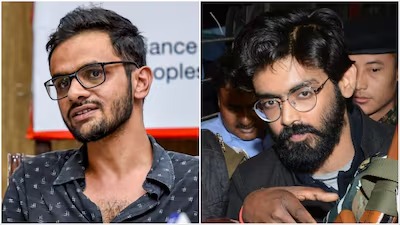
New Delhi: The Supreme Court on Monday refused to grant bail to activists Umar Khalid and Sharjeel Imam in the larger conspiracy case linked to the February 2020 north east Delhi riots, holding that their alleged involvement was central to the conspiracy. The court concluded that the prosecution material, at this stage, discloses a prima facie case against them under the stringent provisions of the Unlawful Activities Prevention Act.
A bench comprising Justices Aravind Kumar and N V Anjaria observed that Khalid and Imam stand on a qualitatively different footing from several other accused in the case. It held that the statutory bar on bail under Section 43D(5) of the UAPA is attracted, as the material on record indicates their roles in the planning and organisational aspects of the alleged conspiracy.
The court underlined that offences concerning the security of the nation require a different approach to bail. It noted that when prosecution allegations appear prima facie true under the UAPA framework, continued incarceration prevails at the bail stage. At the same time, the bench clarified that if the threshold is not met, bail must follow, reaffirming that denial of bail is not automatic.
While rejecting bail for Khalid and Imam, the Supreme Court granted relief to five other accused in the case, emphasising that bail decisions must be based on individual roles. The bench cautioned against treating all accused alike, stating that such an approach could lead to arbitrary pre trial detention.
Addressing arguments related to prolonged incarceration and delay in trial, the court reiterated that personal liberty under Article 21 of the Constitution remains central to the justice system. However, it warned that delay alone cannot serve as a decisive factor for bail in cases involving serious offences under special laws like the UAPA.
The court also clarified the scope of a “terrorist act” under the law, observing that it is not limited to physical violence. Acts that disrupt essential services or destabilise society can also fall within its ambit, reflecting legislative intent to address broader threats.
While denying bail, the Supreme Court allowed Khalid and Imam to move a fresh application after one year or upon completion of the examination of protected witnesses. It directed the trial court to ensure that proceedings are not unnecessarily delayed, stressing the need for timely judicial scrutiny even in cases under special statutes.
Sorry, there was a YouTube error.