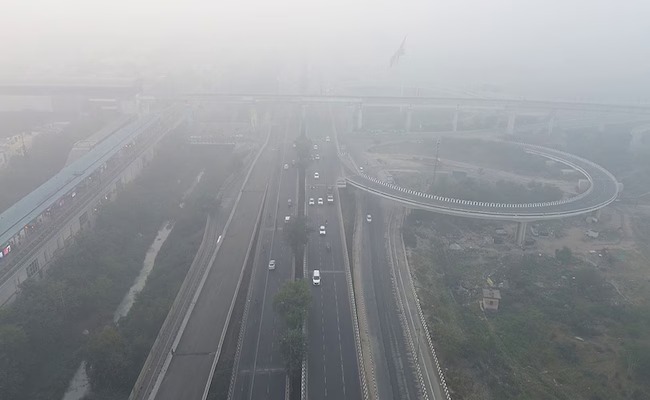
New Delhi: Delhi intensified enforcement at its border entry points on Thursday as air quality levels plunged into the hazardous category, prompting strict implementation of Stage IV of the Graded Response Action Plan. Dense smog reduced visibility across several stretches, including the Delhi Noida Direct Flyway, where the air quality index near the Chilla border touched nearly 490.
Teams from the Delhi Police and the transport department were deployed at multiple checkpoints to monitor incoming traffic. Non compliant vehicles registered outside Delhi were either fined or denied entry. Authorities imposed penalties of up to Rs 20,000 on private and commercial vehicles that failed to meet BS VI emission norms, while others were instructed to turn back immediately. Vehicles without valid Pollution Under Control certificates were also penalised.
Barricades were set up to slow down traffic and allow detailed inspections. Enforcement officers focused on identifying older vehicles, particularly those lacking BS VI blue stickers. Diesel vehicles older than ten years and petrol vehicles older than fifteen years, especially those meeting BS III or lower emission standards, were barred from entering the capital.
Monitoring was carried out using portable verification devices that allowed officials to instantly check vehicle registration details, emission standards, and PUCC validity. Authorities stated that enforcement teams were stationed across all major entry points to prevent vehicles from bypassing checks through alternate routes.
Officials highlighted that vehicular emissions remain a major contributor to Delhi’s winter pollution. Transport accounts for more than 20 percent of PM2.5 levels during this season. Of the nearly 2.88 crore vehicles in the Delhi NCR, a significant share are light motor vehicles and two wheelers, with around 37 percent classified as BS III or older. These vehicles emit substantially higher levels of particulate matter and nitrogen dioxide compared to newer models.
Despite the intensified drive, commuters expressed frustration over what they viewed as uneven enforcement and lack of prior awareness. Concerns were also raised about emissions from public transport and the overall effectiveness of last minute restrictions.
Experts have stressed that while border checks are necessary during pollution spikes, long term solutions are essential. These include stricter and more reliable emission testing, effective vehicle scrappage policies, better coordination between neighbouring states, and significant expansion of public transport. Without such measures, they warn, short term restrictions alone may not deliver sustained improvements in air quality.
Sorry, there was a YouTube error.