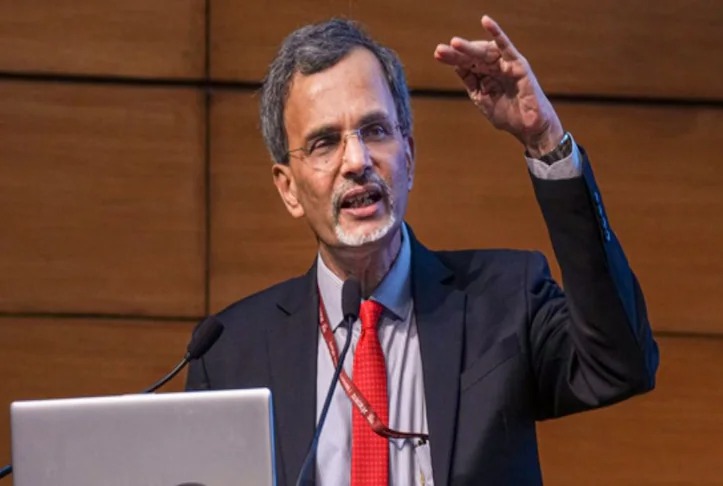
New Delhi: India’s Chief Economic Advisor V Anantha Nageswaran has said that the recent depreciation of the rupee should not be interpreted as a sign of weakness in the country’s economic fundamentals. Instead, he explained that currency movement largely reflects the cautious approach adopted by foreign portfolio investors in response to ongoing global geopolitical and financial uncertainty.
According to Nageswaran, the behaviour of foreign investors cannot be linked to the rupee’s level alone. Capital flows are influenced by a range of global factors, including geopolitical tensions, shifts in monetary policy, and broader risk sentiment. He noted that the rupee’s performance also mirrors a degree of hesitation among foreign institutional investors rather than any domestic macroeconomic stress.
On Thursday, the rupee closed weaker against the US dollar after briefly crossing the 92 mark during intraday trade. Since the beginning of the year, foreign portfolio investors have been net sellers in Indian equity markets, reflecting a broader trend seen across several emerging economies.
Placing the current volatility in a wider context, Nageswaran pointed to the long phase of easy global monetary conditions following the global financial crisis. He observed that years of abundant liquidity led to sharp increases in private credit and elevated asset valuations. As global financial conditions adjust, emerging market currencies and capital flows are experiencing pressure as part of this transition.
Despite these external challenges, the government remains confident about India’s growth prospects. A medium-term growth rate of 7 percent has been projected after accounting for tariff related uncertainty and global risks. Nageswaran highlighted that this outlook is supported by domestic structural reforms, financial system resilience, and a calibrated trade strategy.
He clarified that the growth projection does not depend on the conclusion of an India–US trade agreement, though such a deal would add comfort to the outlook if finalised during the year. The government, he said, continues to pursue long-term policy clarity through deregulation in sectors such as insurance and nuclear energy, which is expected to support foreign direct investment.
Nageswaran also emphasised that both labour-intensive and capital-intensive industries have scope to expand simultaneously. He added that several recently signed free trade agreements are expected to become operational within the year, which should help boost exports and strengthen India’s integration into global value chains.
Sorry, there was a YouTube error.