NEW DELHI: On the sidelines of the ongoing 17th BRICS Summit in Brazil, External Affairs Minister S Jaishankar held a series of important bilateral meetings with his counterparts from Russia, Iran, and Mexico, focusing on strengthening partnerships and discussing pressing regional and global issues.
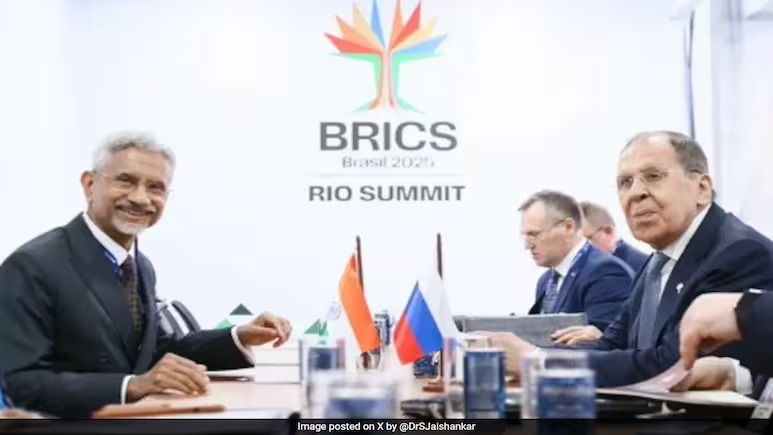
Jaishankar met Russian Foreign Minister Sergey Lavrov, where the two leaders discussed wide-ranging topics, including bilateral cooperation, developments in West Asia, and engagement through key multilateral platforms such as BRICS and the Shanghai Cooperation Organisation (SCO).
“Good to meet with FM Sergey Lavrov of Russia on the sidelines of #BRICS2025,” Jaishankar posted on social media platform X, reflecting the strategic importance of India-Russia ties amidst a shifting global order.
In another key meeting, Jaishankar met Iranian Foreign Minister Seyed Abbas Araghchi, where the focus was on evolving regional dynamics.
“Glad to meet FM @araghchi of Iran this (Sunday) evening. Our conversation focused on recent regional developments,” Jaishankar wrote, hinting at discussions that likely included West Asia tensions, connectivity projects like Chabahar Port, and energy cooperation.
With Mexican Foreign Secretary Juan Ramon de la Fuente, Jaishankar explored avenues to advance the India-Mexico bilateral partnership, particularly in sectors such as healthcare, digital innovation, space collaboration, and technology exchanges. The talks underscore India’s intent to expand its global engagements beyond traditional partners.
These high-level meetings were held in the backdrop of a significantly expanded BRICS grouping. Originally comprising Brazil, Russia, India, China, and South Africa, BRICS was joined by Egypt, Ethiopia, Iran, and the United Arab Emirates in 2024. Indonesia became the latest member in 2025, reflecting the growing influence and reach of the bloc.
Today, BRICS represents 11 major emerging economies, accounting for nearly 49.5% of the global population, around 40% of the world’s GDP, and 26% of global trade. As the grouping’s geopolitical weight increases, India’s proactive diplomacy — including Jaishankar’s outreach to key players — underscores its leadership role in shaping the future of multilateral cooperation.
Sorry, there was a YouTube error.