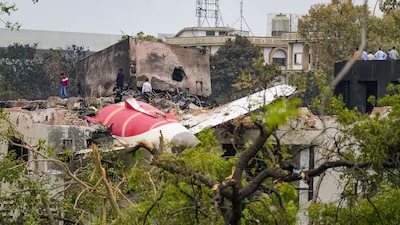
New Delhi: The Supreme Court on Thursday emphasised that the pilots of Air India flight AI-171 cannot be held responsible for the 12 June crash, as the Centre reiterated that the ongoing investigation by the Aircraft Accident Investigation Bureau is intended solely to identify the cause of the tragedy. The court noted that the inquiry is designed to deliver corrective safety recommendations rather than assign fault to individuals. More than 250 people, including crew members and bystanders on the ground, lost their lives in the accident.
During the hearing before Justices Surya Kant and Joymalya Bagchi, the Solicitor General stated that the investigation is being conducted strictly in line with international aviation norms. He explained that the International Civil Aviation Organisation mandates a detailed and technical approach to all crash inquiries. A clarification issued earlier by the Ministry of Civil Aviation, he added, had already addressed misconceptions arising after the preliminary AAIB report, making it clear that no blame had been cast on the pilots or any other party.
The bench reaffirmed that the primary goal of the investigation is to determine what caused the aircraft to crash and to prevent similar incidents in the future. The judges sought a detailed response from the Centre while hearing a petition filed by the father of Captain Sumeet Sabharwal, one of the pilots who died in the crash. His counsel argued that essential ICAO standards had not been fully followed, raising concerns about the robustness of the inquiry.
Representing an NGO, another counsel called for an independent court of inquiry, citing concerns over broader systemic issues linked to the Boeing 787 aircraft model. He warned that without a comprehensive investigation, passenger safety could be compromised. The Solicitor General, however, cautioned against creating unnecessary alarm and urged the court to allow the inquiry to continue without interruptions.
The petitioners have also challenged early observations suggesting possible human error, arguing that such remarks are premature without ruling out electrical or software-related failures. The preliminary findings noted unexpected movement of both engine fuel control switches to CUTOFF shortly after take-off, resulting in loss of thrust and a Mayday call moments before impact.
The matter will be heard again once the Centre files its detailed affidavit, with the court consistently stressing the need for a transparent and expert-led investigation into one of the country’s most devastating aviation disasters.
Sorry, there was a YouTube error.