Team Goemkarponn
PANAJI: The recent stampede at the Lairai Jatra festival in Shirgaon, which occurred on May 3, 2025, has been declared a preventable tragedy by a Fact-Finding Inquiry Committee (FFIC) appointed by the government.
The committee’s exhaustive report, released this week, uncovers a troubling chain of administrative failures and neglected warnings that culminated in the deaths and injuries of numerous devotees during one of Goa’s most revered religious festivals.
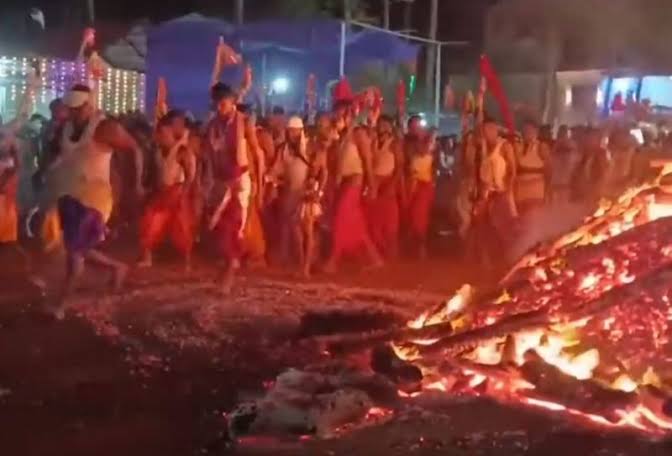
The stampede took place during the early morning hours of the Homkhand ritual—a central event in the Jatra—when thousands of barefoot devotees, known as Dhonds, gathered to fulfill their vows.
According to the report, the incident was triggered by overcrowding along a narrow, sloped pathway near the RBL Bank branch, as devotees moved from Devichi Tali (holy pond) toward the Homkhand.
A sudden forward push by some unruly Dhonds caused a woman to fall, leading to a cascade of people toppling over each other due to the downward slope and dense crowd.
Crucially, the committee noted that there was no CCTV surveillance or drone monitoring active during this high-risk time period, despite repeated past warnings.
The committee has placed primary responsibility on the Shree Lairai Saunsthan Temple Management Committee for its failure to implement critical crowd control measures.
Despite warnings from police and district authorities, the committee ignored directives to install temporary surveillance equipment and failed to prevent roadside stalls from being erected along the pathway.
These stalls significantly reduced available space and contributed to the deadly congestion. Additionally, the committee neglected to prepare a proper event management plan, nor did it undertake any crowd risk assessment based on past experiences, even though smaller incidents had reportedly occurred during previous years.
The district administration and police were also faulted for ineffective coordination and lax enforcement of safety protocols. While pre-event meetings were held, the administration did not issue enforceable orders to prevent stall installation, and there was no high-level review by the District Magistrate before the event.
The police, though they increased personnel this year, were found to have poorly defined sector responsibilities and failed to use alternate crowd routes.
Surveillance towers were not installed as planned, and drone equipment was not deployed during peak hours for reasons that remain unclear.
The Shirgaon Village Panchayat, too, came under criticism for issuing No Objection Certificates (NOCs) for electricity connections to unauthorized stalls, directly contradicting safety instructions provided during coordination meetings.
The report describes this act as an indirect but substantial contributor to the narrowing of the pathway where the stampede occurred.
In its conclusion, the Fact-Finding Committee emphasized that this was not an unavoidable disaster but a series of preventable errors. The tragedy was the result of ignored warnings, mismanagement, and a lack of accountability across all levels of governance.
The report also highlighted a cultural reluctance to enforce safety directives in the context of religious sentiments, which allowed critical issues to go unaddressed.
The FFIC underscored that religious festivals, particularly those of this scale, must be treated as complex public events requiring logistical precision and safety-first approaches.
Among its many recommendations, the committee called for a detailed government inquiry to determine individual accountability and proposed dissolving the existing temple management committee if warranted.
It urged the implementation of a formal Event Management Plan (EMP) following NDMA guidelines, the use of surveillance tools including CCTV and drones, clear demarcation of crowd movement routes, regulation of roadside vendors, and standard operating procedures to ensure legal enforceability of safety measures.
The report concluded with a stark reminder: behind each casualty was a grieving family who had placed their trust in the sanctity and safety of the festival. It calls for this tragedy to become a turning point—a catalyst for reform, not just in Shirgaon, but across all public festivals in Goa. The state government is expected to respond formally to the report, as public outcry and calls for accountability continue to grow.