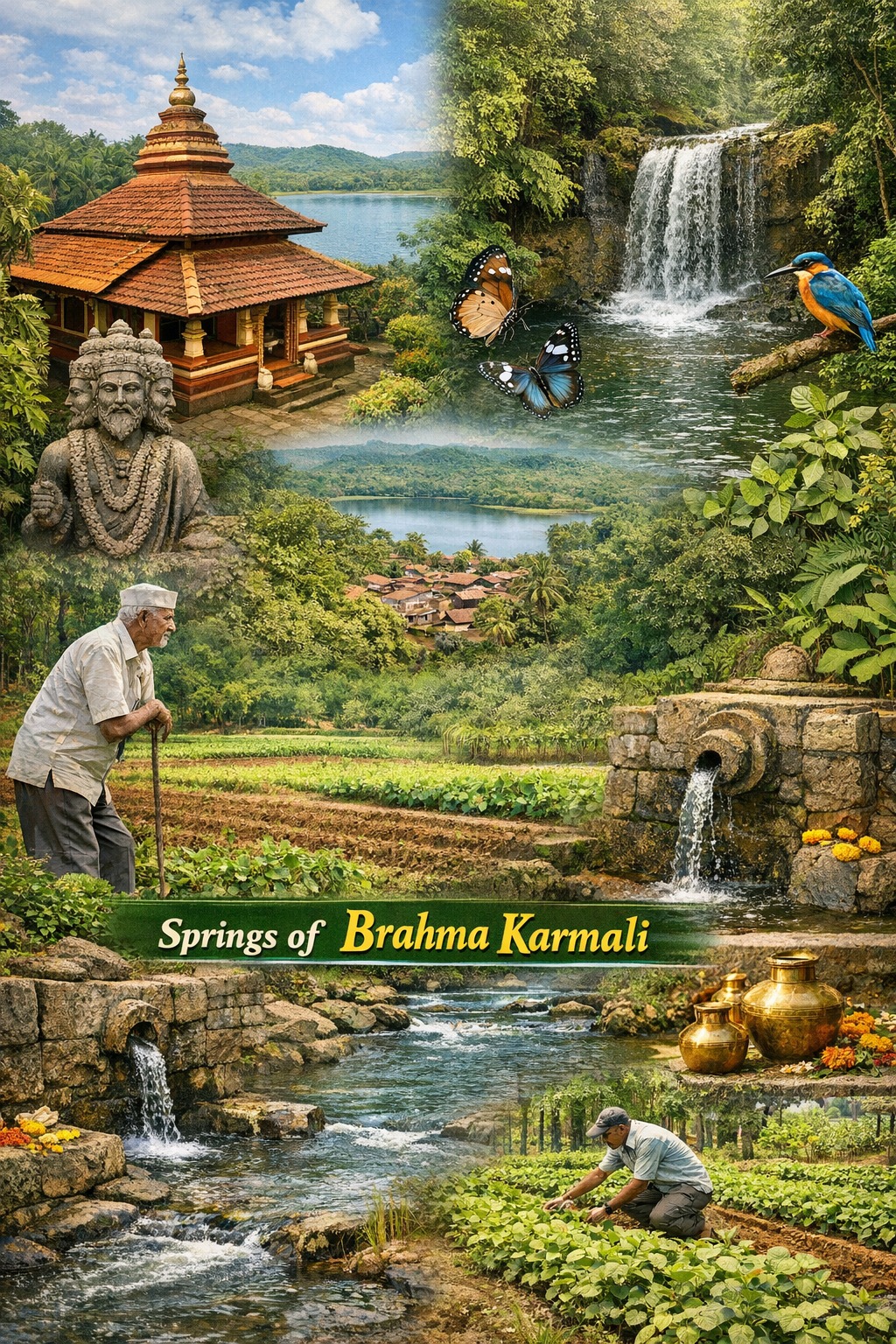
Brahma Karmali, a village known for housing the only Brahmadev temple in Goa and the Konkan region, has long been sustained by numerous perennial springs. Among these, four major springs play a particularly crucial role in the ecological and cultural life of the village.
Centuries ago, Brahmin communities from the Konkan region chose to settle here, drawn by the presence of perennial springs and favourable climatic conditions. The unique sculpture associated with the Brahmadev temple, reflecting the heritage of the Goa-Kadamba period, is believed to have been brought from Carambolim. The area, once known as Chandiwade due to the abundance of Macaranga peltata trees, gradually came to be known as Brahma Karmali.
Among the four prominent springs, the Bibtyan spring is particularly significant. This perennial spring has, for generations, quenched the thirst of villagers and irrigated horticultural fields across Brahma Karmali, Nagargao, Satode, and Hedode. The presence of the rare vegetation Semecarpus kathlekanensis has brought this spring recognition in India’s botanical heritage.
Sumitra Nadkarni, a resident of Brahma Karmali, says, “The water from this spring has quenched our thirst for decades. We consider ourselves fortunate to have access to such pure and tasty water, which we believe also has medicinal properties.”
Another important spring, Ajobachi Tali, has continuously supported the rich floral and faunal diversity within the forest patches of the Mhadei Wildlife Sanctuary for generations. Historically, its water is believed to have been used by prehistoric communities inhabiting the Dudin Sada region. The swamp created by this spring attracts a wide range of butterflies, reptiles, birds, and other wildlife.
Seventy-two-year-old Vishnu Harvalkar recalls, “In the past, large stretches of autumn agricultural fields were irrigated by water from this spring.”
Bagatali Zor, once a primary source of drinking water for many families in Brahma Karmali, has gradually faded from everyday use with the introduction of tap water. Despite this shift, it continues to support horticultural activities.
Horticulturist Milind Gadgil notes, “We have been using the water from this spring for our horticultural fields for many generations, ensuring its continued relevance.”
Brahmadevachi Zor holds deep religious significance. The water from this sacred spring is used daily for rituals and ceremonies at the Brahmadev temple. According to local folklore, members of the Gawda tribal community who brought the Brahmadev idol from Carambolim were captivated by the beauty of the area. One among them is believed to have dreamt of Brahmadev expressing a desire to reside there. This led to the establishment of the temple, and the spring came to be known as Brahmadevachi Zor.
Every year, March 22 is observed as World Water Day. On this occasion, it is essential to reflect on and plan strategies for the protection and conservation of precious water resources such as springs, streams, tanks, and rivers.
The springs of Brahma Karmali are not just sources of water, but living symbols of heritage, ecology, and community life. Preserving them is vital for sustaining both nature and tradition for generations to come.