New Delhi:
Statue Of Chhatrapati Shivaji Installed At 14,300 Feet Near India-China Border
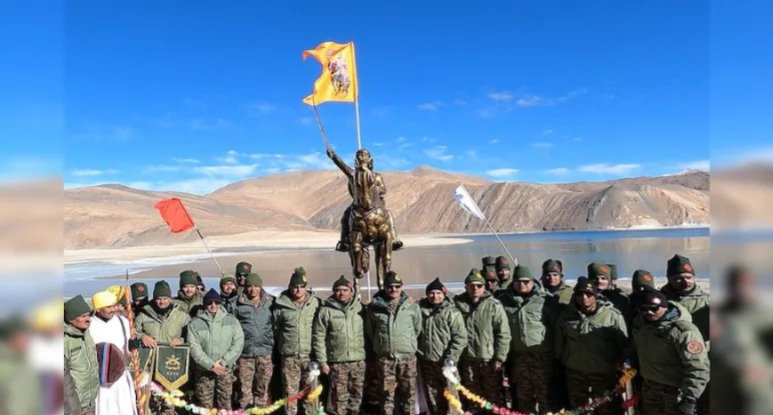
In a significant gesture that combines historical reverence with contemporary strategic significance, the Indian Army has unveiled a 30-foot tall statue of the legendary Maratha warrior king, Chhatrapati Shivaji, on the banks of Pangong Tso in the eastern Ladakh sector. This installation, at an altitude of 14,300 feet, is not only a tribute to Shivaji’s military prowess and leadership but also a symbol of India’s unwavering spirit and commitment to its rich cultural and historical heritage.
The statue was inaugurated on December 26 by Lt Gen Hitesh Bhalla, the General Officer Commanding of the Leh-based 14 Corps, also known as the Fire and Fury Corps. Lt Gen Bhalla, who is also the Colonel of The Maratha Light Infantry, a regiment closely associated with the Maratha legacy, highlighted the importance of Shivaji’s legacy in inspiring generations.
“The event celebrates the unwavering spirit of the Indian ruler, whose legacy remains a source of inspiration for generations,” stated the 14 Corps on X (formerly Twitter). The statue, described as a “towering symbol of valour, vision, and unwavering justice,” stands as a testament to Shivaji’s enduring impact on Indian history and military strategy.
Strategic Significance and Historical Context
The location of the statue is particularly noteworthy, given its proximity to the Line of Actual Control (LAC) with China. Pangong Tso, a 135-kilometer glacial lake, has been a site of significant military activity in recent years. The eastern Ladakh border standoff, which began on May 5, 2020, following a violent clash in the Pangong lake area, has been a major point of contention between India and China. However, following a series of military and diplomatic talks, the two sides completed the disengagement process in 2021 on the north and south banks of the Pangong Tso. The recent disengagement at the last two friction points of Demchok and Depsang, completed after an understanding reached on October 21, marks a significant de-escalation in the nearly four-and-a-half-year-long border standoff.
Integration of Ancient Strategic Acumen
The installation of the Shivaji statue is part of a broader initiative by the Indian Army to integrate India’s ancient strategic acumen into the contemporary military domain. This effort reflects a deeper understanding of how historical military strategies and leadership can inform and enhance modern military operations. Projects such as Udbhav, spearheaded by the Centre for Military History and Conflict Studies (CMHCS) of the United Service Institution of India, aim to bridge the past and the present by tracing the evolution of Indian military systems, strategy, and statecraft.
Modern Military Innovations
In addition to honoring historical figures, the Indian Army is also at the forefront of modern military innovations. Initiatives like Inno-Yoddha 2024-25, which recently concluded at the Manekshaw Centre in New Delhi, highlight the Army’s commitment to innovation and excellence. This annual event focuses on identifying in-house innovations that can enhance operational effectiveness, bolster logistics, and improve training methods, all of which are crucial in the complex and dynamic environments faced by modern militaries.
The unveiling of the Chhatrapati Shivaji statue at Pangong Tso is a powerful symbol of India’s rich cultural heritage and its unwavering commitment to its military traditions. As the Indian Army continues to evolve and adapt to the challenges of modern warfare, it is clear that the legacy of historical figures like Shivaji will remain a vital source of inspiration and strategic insight.