Team Goemkarponn
Panaji: Chief Minister Pramod Sawant announced that a stop work order would be issued against a proposed large-scale construction project in Carambolim, responding to sustained opposition from local residents and activists over alleged planning and infrastructure concerns.
In an official statement, Sawant said he had discussed the matter with Town and Country Planning Minister Vishwajit Rane and had also informed RGP MLA Viresh Borkar about the government’s decision. He added that formal action against the project would follow shortly.
Sawant said that a notice would first be served on the developer, and that a stop work order would be approved at the next meeting of the Town and Country Planning (TCP) Board, scheduled to be held within the next three days.
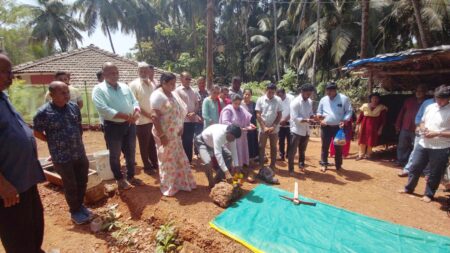
The Chief Minister’s assurance came after villagers from Carambolim staged a sit-in protest at the TCP office in Panaji against the proposed project. The protest, which continued through the day and was called off late in the night, was led by Viresh Borkar.
Residents are opposing a development proposal that includes 84 residential apartments, 46 commercial units and a swimming pool on land currently accessed by a narrow 3–4 metre road. Protesters have objected to permissions being granted based on a proposed 15-metre-wide road, arguing that such approvals do not reflect ground realities.
Villagers have warned that the project would severely burden Carambolim’s already stressed infrastructure, particularly roads, water supply and basic civic services. They also flagged the project’s proximity to a Hindu crematorium and pointed to an existing water deficit of around 3.45 million litres per day, raising concerns over public safety and sustainability.
Despite objections raised by the Village Panchayat and the Gram Sabha, the project had received provisional clearance from the TCP department, fuelling public anger.
Earlier in the day, protesters marched to the TCP office seeking clarification from officials but were stopped by police. While TCP officials offered to hold talks with a limited delegation of five representatives, the villagers rejected the proposal, insisting that officials address the gathering as a whole.
Following the standoff, residents staged a sit-in at the TCP office entrance, demanding greater transparency and a comprehensive review of the project approvals. Protesters warned that unchecked large-scale developments could have irreversible consequences for the village.
After prolonged protests, a delegation led by Borkar was eventually allowed to meet the Chief Town Planner.
Speaking to protesters after the meeting, Borkar alleged serious irregularities in the functioning of the TCP department. He claimed that permissions were being granted despite glaring shortcomings on the ground and alleged that site inspections were “pre-determined rather than genuine.”
Borkar further accused the TCP department of yielding to political pressure, alleging that planning laws were manipulated, files cleared in haste and officers pressured to approve projects, while objections raised by local residents were routinely ignored.