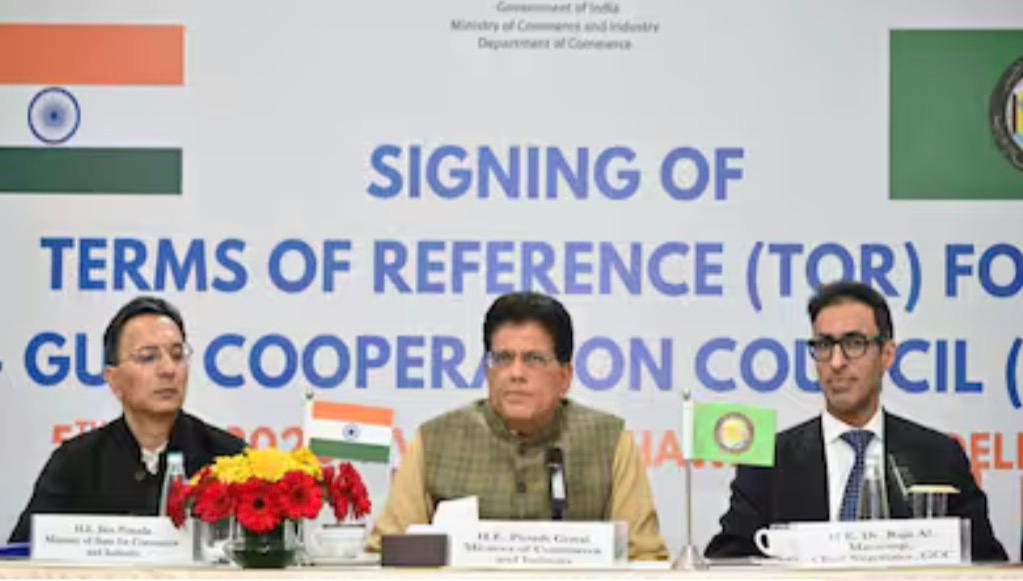
New Delhi: India has formally restarted negotiations for a free trade agreement with the Gulf Cooperation Council, turning its focus to the West Asian region soon after concluding major trade understandings with the European Union and the United States. The two sides signed the Terms of Reference in New Delhi on Thursday, marking the official resumption of a dialogue that had remained suspended for more than a decade.
The Gulf Cooperation Council brings together Saudi Arabia, the United Arab Emirates, Qatar, Kuwait, Oman and Bahrain. Formed in 1981, the grouping promotes cooperation in economic, industrial and scientific fields among its members. India has maintained deep links with these nations through energy trade, investment and a large expatriate community of nearly ten million people working across the region.
Bilateral commerce between India and the Gulf bloc has grown steadily in recent years. Trade stood at around 155 billion dollars in 2021 to 2022 and rose to nearly 185 billion dollars in 2022 to 2023. In the period 2024 to 2025, the figure reached 178.7 billion dollars with Indian exports touching 56.9 billion dollars and imports valued at 121.7 billion dollars. The United Arab Emirates emerged as India’s third largest trading partner during the last fiscal year.
Negotiations for a comprehensive pact were first launched in 2004 and continued through several rounds before being put on hold in 2011 when the Gulf bloc paused all external trade discussions. Talks were revived in 2022 and a revised framework was exchanged in 2023, paving the way for the present agreement to move forward. The first round of formal negotiations is expected to take place in Riyadh.
India views the proposed agreement as a major opportunity to expand exports, attract investment and secure long term energy cooperation. Removal of duties and non tariff barriers is expected to benefit sectors such as petrochemicals, infrastructure, information technology and food processing. For the Gulf nations, closer engagement with India offers access to a large and stable market at a time of global uncertainty.
India already has modern trade pacts with the United Arab Emirates and Oman. A region wide arrangement with the entire Gulf Cooperation Council would bring coherence to existing partnerships and strengthen economic ties that have evolved over thousands of years.