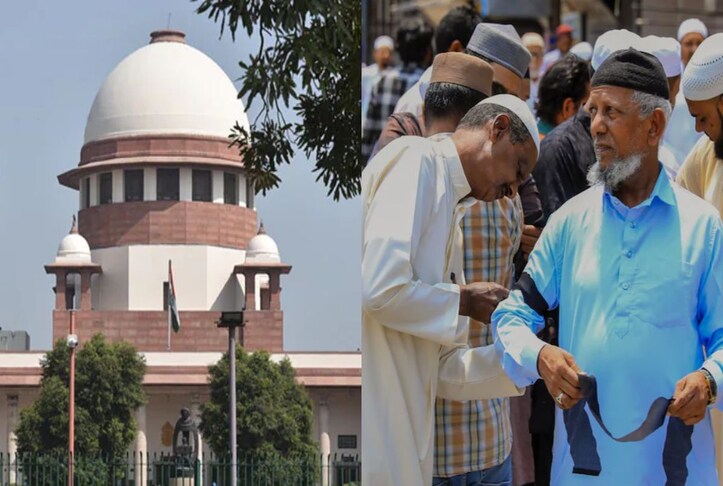
New Delhi: The Supreme Court on Sunday paused key provisions of the contentious Waqf (Amendment) Act, which has triggered widespread protests across the country. The bench, comprising Chief Justice of India BR Gavai and Justice AG Masih, observed that certain provisions of the amended law could result in an “arbitrary” exercise of power, particularly by granting sweeping authority to district Collectors.
While the court clarified that the entire Act need not be stayed, it highlighted that some sections require interim protection until the petitions challenging the constitutionality of the law are thoroughly examined. The bench noted that allowing a district Collector to adjudicate property rights of individuals would contravene the separation of powers and disrupt the legal framework. “Till adjudication happens by the tribunal, no third-party rights can be created against any party. The provision dealing with such powers to the Collector shall remain stayed,” the court said.
The new legislation had empowered District Collectors as the final authority in resolving disputes over Waqf property ownership. It stated that if the Collector’s report flagged a property, wholly or partially, as disputed or government land, it would not be registered as Waqf unless the dispute was settled by a competent court. Protesters, including Muslim organisations, argued that this would encourage illegitimate claims on Waqf assets and compromise their protection.
The bench further addressed other contentious provisions, such as the inclusion of non-Muslim members on Waqf boards. It ruled that no more than three non-Muslim members should be allowed on a state Waqf board and no more than four in the Central Waqf Council. The court also paused the clause requiring a person to be a practicing Muslim for at least five years to declare a Waqf, warning that “without any mechanism, it will lead to an exercise of arbitrary power.”
The court emphasized that while it typically presumes the constitutionality of a law, intervention is warranted only in “rarest of rare cases.” The amended Waqf Act, which passed Parliament and received presidential assent in April, had drawn sharp criticism from Muslim bodies, who alleged that it was unconstitutional and aimed at facilitating the takeover of Waqf properties. The government, however, defended the law, arguing that it sought to address long-standing disputes and encroachments on Waqf lands.
Among the petitioners was the All India Muslim Personal Law Board (AIMPLB), a prominent body representing Muslim interests. AIMPLB member Syed Qasim Rasool Ilyas welcomed the court’s intervention, stating that many of their concerns had been acknowledged. “Our point on ‘Waqf by User’ has been accepted. Likewise, our point regarding protected monuments has also been upheld, ensuring that third-party claims will not be entertained. The five-year requirement for declaring Waqf has been removed. By and large, many of our points have been accepted, and we are satisfied to a large extent,” he said.
The court’s interim order marks a significant step in the ongoing debate over the Waqf Amendment Act and its implications for minority rights, property disputes, and administrative powers.