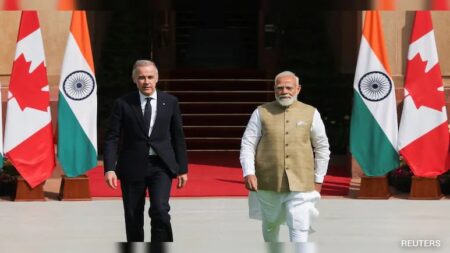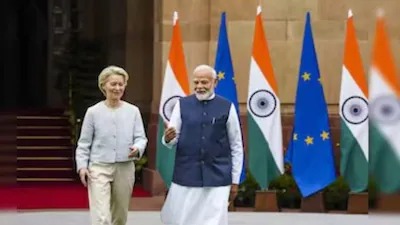
New Delhi: Senior European Union officials have described the forthcoming 16th India European Union Summit as a transformational moment in global geopolitics, signalling a major leap in bilateral relations. The summit is expected to mark the adoption of a Comprehensive Strategic Agenda for 2030, laying the foundation for deeper cooperation across trade, security, technology, and regional stability.
A central focus of the discussions is the near finalisation of a long pending Free Trade Agreement. The deal has been portrayed as a landmark economic partnership that could bring together a combined market of nearly two billion people and represent close to one quarter of global economic output. For the EU, the agreement is seen as a crucial step toward diversifying trade partnerships, as India’s current share in EU trade remains relatively modest compared to other major economies.
The proposed trade pact aims to provide greater market access and long term predictability for businesses on both sides, while encouraging collaboration in areas such as digital innovation, clean energy, and resilient supply chains. However, negotiations are still addressing sensitive issues, including climate related trade measures and alignment with international environmental commitments.
Beyond trade, the summit is expected to introduce a new Security and Defence Partnership, marking the first such framework between India and the EU. This initiative reflects a shared interest in responding to evolving geopolitical challenges and strengthening cooperation in the Indo Pacific region.
Another key outcome will be a Memorandum of Understanding on mobility, designed to streamline legal pathways for Indian professionals, students, and researchers seeking opportunities in Europe. The initiative is intended to support Europe’s workforce requirements while creating avenues for skill development and knowledge exchange.
Regional connectivity and security issues will also feature prominently. The India Middle East Europe Economic Corridor remains on the agenda despite recent regional tensions, underlining its long term strategic importance. Discussions are also expected on cross border terrorism and broader regional stability.
By endorsing a new five year strategic roadmap, India and the EU aim to reinforce a rules based multilateral order and position their partnership as a stabilising force in an increasingly complex global landscape.
Sorry, there was a YouTube error.