New Delhi, June 23: US President Donald Trump has claimed “monumental damage” was inflicted on Iran’s key nuclear sites following a massive overnight military strike carried out as part of Operation Midnight Hammer. The US joined Israel in launching precision air and missile attacks on Iran’s highly fortified nuclear facilities at Fordow, Natanz, and Isfahan, sparking global concerns of a major escalation in the Middle East.
In a post on his social media platform Truth Social, Trump described the attacks as a “bullseye” and stated, “Obliteration is an accurate term!” He praised the US military’s precision and added, “Monumental damage was done to all nuclear sites in Iran… The biggest damage took place far below ground level.”
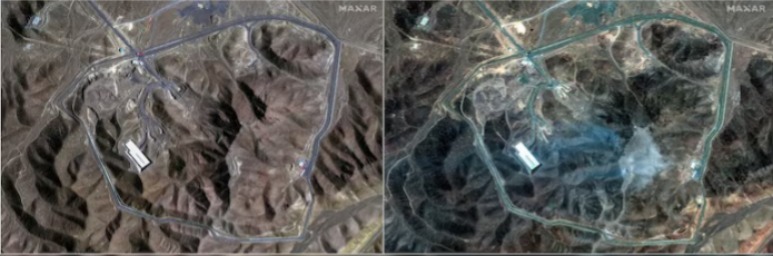
While Trump did not share images, satellite data reviewed by multiple security experts points to significant damage at the Fordow facility — one of Iran’s most secretive and heavily fortified underground nuclear enrichment sites. The imagery shows six impact points on the mountain above Fordow, consistent with the use of GBU-57/B Massive Ordnance Penetrator (MOP) bombs, designed to destroy deep underground bunkers.
According to General Dan Caine, Chairman of the US Joint Chiefs of Staff, seven B-2 stealth bombers dropped a total of 14 MOPs on Fordow in a coordinated “double tap” attack — the bombs hitting the same spots twice to ensure destruction. In addition, 30 Tomahawk cruise missiles targeted Isfahan and Natanz, while F-22 Raptors and F-35A Lightning fighters provided aerial support.
The International Atomic Energy Agency (IAEA), however, reported no immediate increase in off-site radiation levels. IAEA Director General Rafael Grossi called for calm and offered to mediate, reiterating that “efforts must now focus on peace.”
Despite the scale of the strike, analysts say full confirmation of the extent of destruction remains elusive due to the depth and shielding of Iran’s underground facilities. “The hall containing hundreds of centrifuges is too deeply buried for us to evaluate based on satellite imagery alone,” said Decker Eveleth, a satellite imagery analyst with CNA Corporation.
Further complicating matters, satellite images taken prior to the strike showed “unusual activity” at Fordow, including a long convoy of vehicles outside the facility. Reuters, citing Iranian sources, reported that much of Iran’s 60% highly enriched uranium stockpile had been moved to an undisclosed location ahead of the US attack, indicating Tehran may have anticipated the strike.
Several experts warned that Iran likely still possesses components and material for its nuclear program hidden across undisclosed sites. “You can probably only set their program back by a few years,” said Jeffrey Lewis of the Middlebury Institute of International Studies. “There are almost certainly facilities we don’t know about.”
Amid rising tensions, Iran’s Supreme Leader Ayatollah Ali Khamenei broke his silence on the strikes, promising continued retaliation. Referring to Israel as the “Zionist enemy,” Khamenei said, “It must be punished and it is being punished right now.” He shared a symbolic image of airstrikes, with a skull bearing the Star of David, further signaling Tehran’s defiance.
In the hours following the US strike, Iran’s Islamic Revolutionary Guard Corps (IRGC) launched at least 40 missiles, including the long-range Khorramshahr-4, targeting Israeli sites in response. Khamenei’s close aide, Hossein Shariatmadari, urged immediate retaliation, calling for missile strikes on the US naval fleet in Bahrain and the closure of the Strait of Hormuz, a critical global oil shipping corridor.
The US and Israel have long maintained that Iran’s nuclear ambitions pose a direct threat to regional and global security. While Iran insists its nuclear program is for peaceful purposes, the country is now threatening to withdraw from the Nuclear Non-Proliferation Treaty (NPT) — a move that would cut off international oversight and cooperation with the IAEA.
In addition to the damage at Fordow, satellite imagery showed serious structural impacts at Natanz and Isfahan. Former UN nuclear inspector David Albright confirmed significant destruction to the underground enrichment halls at Natanz, while cruise missiles struck a uranium facility in Isfahan, though questions remain about whether the deeper tunnel complex there was penetrated.
There are also growing concerns over a new uranium enrichment facility Iran had planned in Isfahan, with Albright raising the question: “Where are the 2,000 to 3,000 centrifuges slated for this new plant?”
US officials, while celebrating the precision of the strikes, remain cautious. “Initial assessments suggest severe damage, but we are still evaluating if any key infrastructure remains intact,” General Caine stated.
As fears of a broader conflict mount, US Senator Mark Kelly, a member of the Senate Intelligence Committee, expressed concern that Iran may now take its entire program “under the radar,” complicating detection and containment efforts.
The coming days are expected to be critical, with Iran threatening further military responses and the international community urging restraint. With nuclear tensions at their highest point in years, the global stakes — from diplomacy to oil prices — are rising rapidly.
Sorry, there was a YouTube error.