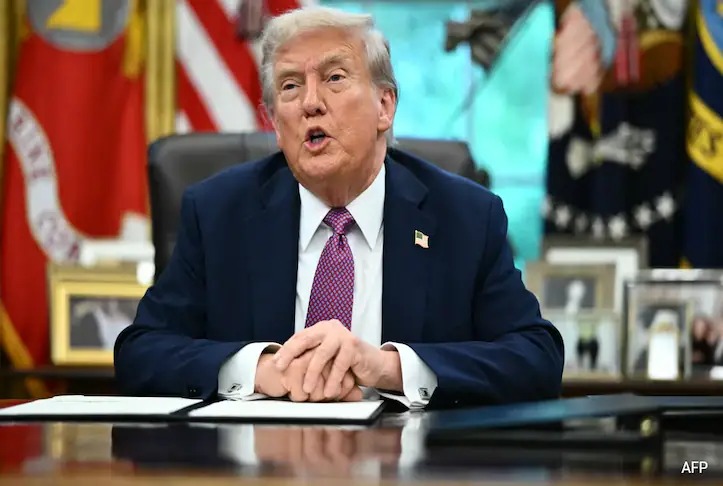
New Delhi: In a major move to tighten immigration rules, US President Donald Trump has signed a proclamation imposing a $100,000 (₹88 lakh) fee on H-1B visa applications. The decision could significantly impact the tech sector, which depends heavily on skilled workers from India and China.
President Trump said the measure is designed to ensure that only “very highly skilled” workers are brought into the country and that they do not displace American employees.
“We need workers. We need great workers, and this pretty much ensures that’s what’s going to happen,” Trump said while announcing the new fee.
White House staff secretary Will Scharf called the H-1B program one of the “most abused visa systems” and said the steep fee would force companies to be more selective about whom they sponsor.
The H-1B visa is a non-immigrant work permit that allows US companies to hire foreign professionals in specialised fields like science, technology, engineering, and mathematics (STEM). Created in 1990, it is initially valid for three years and can be extended up to six years.
Applications are submitted online to the US Citizenship and Immigration Services (USCIS) and are typically chosen through a lottery system. The visa ensures equal pay and working conditions comparable to US employees.
Indians consistently make up the largest share of H-1B visa recipients, accounting for 71% of approved visas last year, according to government data. Tech giants like Amazon, Microsoft, and Meta collectively secure thousands of H-1B visas annually for skilled Indian workers.
However, the new $100,000 fee could make renewals prohibitively expensive, especially since many Indian professionals must renew their visas multiple times while waiting for permanent residency (Green Card) approval — a process that can take years.
Alongside the H-1B changes, the Trump administration is reinstating a more difficult citizenship test requiring applicants to answer 12 of 20 oral questions from a pool of 128 on US history and civics a policy scrapped under President Biden.
Trump also unveiled a ‘Gold Card’ visa program that offers residency for a fee — $1 million for individuals and $2 million for businesses. The program aims to attract “extraordinary” talent and entrepreneurs who can create jobs in the US.
Commerce Secretary Howard Lutnick defended the reforms, calling the current employment-based Green Card program “illogical,” noting that it was bringing in workers from the “bottom quartile” of earners.
“We are going to stop doing that,” Lutnick said. “This will raise billions, reduce taxes, pay off debt, and bring in only top talent.”
The dramatic hike in H-1B visa fees could reshape the talent flow between India and the US, forcing companies to rethink hiring strategies and leaving many Indian tech workers reconsidering their American dream.