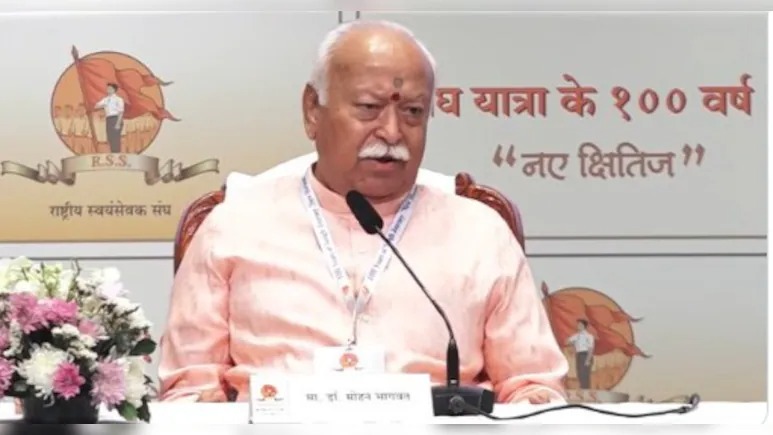
New Delhi: Rashtriya Swayamsevak Sangh chief Mohan Bhagwat on Sunday said that any move to introduce a Uniform Civil Code should be undertaken only after taking all sections of society into confidence and ensuring that it does not become a source of discord. He made the remarks while interacting at an event held to mark the centenary year of the organisation.
Addressing a range of contemporary issues, Bhagwat also spoke about the recent trade understanding between India and the United States. He said every international agreement involves compromise from both sides and stressed that India must ensure such deals remain beneficial and balanced rather than resulting in any loss to national interests.
On the long standing demand from some quarters to confer the Bharat Ratna on Hindutva thinker Veer Savarkar, the RSS chief said the honour would only add to the prestige of the award. He remarked that Savarkar already occupies a respected place in the hearts of millions and recognition from the state would further strengthen that legacy.
Bhagwat devoted considerable time to the subject of caste and its role in present day politics. He observed that the original occupational basis of the caste system has largely disappeared and that caste identities are now used mainly for personal gain and electoral calculations. According to him, political parties continue to rely on caste equations because these identities remain deeply rooted in society.
He called for a sensitive and thoughtful approach to deal with caste related conflicts, warning that confrontational politics could deepen social fault lines. The RSS, he said, does not believe in selecting leaders on the basis of caste background and the only essential qualification for the post of Sarsanghchalak is commitment to Hindu values.
Rejecting allegations that the organisation favours any particular community, Bhagwat explained that early office bearers happened to belong to one social group only because the Sangh began in a limited locality. As the organisation expanded geographically, its composition also became more diverse.
He emphasised that leadership positions are decided on the basis of competence, dedication and availability rather than caste identity. Being from a scheduled caste or tribe is not a disadvantage, he said, and belonging to any other group is not an advantage. The guiding principle, he added, remains the ability to serve the organisation and society effectively.