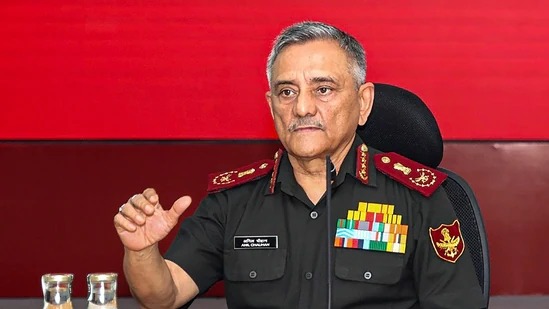
Pune: Chief of Defence Staff (CDS) General Anil Chauhan has said that employing the Indian Air Force (IAF) during the 1962 Sino-Indian war could have significantly slowed the Chinese advance, giving the Army more time to prepare.
Speaking through a recorded video message at the launch of the revised autobiography of late Lt Gen S.P.P. Thorat Reveille to Retreat in Pune on Wednesday, General Chauhan said the decision not to use air power during the conflict was a missed opportunity.
“Use of air power would have slowed the Chinese offensive considerably, if not stymied it completely,” he said. “In those days, the use of the Air Force was seen as escalatory. This is no longer the case, as demonstrated during Operation Sindoor.”
Operation Sindoor, conducted in May this year, involved the IAF striking terror hubs in Pakistan and PoK following the Pahalgam massacre.
Reflecting on India’s forward policy of the early 1960s, General Chauhan said it should not have been applied uniformly in Ladakh and NEFA (present-day Arunachal Pradesh) due to the two regions’ vastly different historical disputes and terrain.
“In Ladakh, China had already occupied much of Indian territory, whereas in NEFA the legitimacy of India’s claim was stronger. Pursuing identical policies in both regions was, in my view, flawed,” he remarked.
He noted that while geography and geopolitics have changed since 1962, the conflict remains a subject of military and strategic study.
General Chauhan praised Lt Gen Thorat’s memoir, calling it “more than just a soldier’s autobiography” and an important reflection on leadership, military strategy, and the decisions that shaped India’s defence posture.
“Reveille to Retreat critiques key decisions with honesty and draws lessons that remain relevant even today,” he said.
Lt Gen Thorat, who served as General Officer Commanding-in-Chief of Eastern Command in the lead-up to the 1962 war, had a distinguished career spanning pre- and post-Independence India. He commanded his battalion in Burma’s Arakan region during World War II, fought in the battles of Kohima and Imphal, and later commanded the Custodian Force in Korea after the Armistice.
For his service, he was awarded the Distinguished Service Order, the Ashoka Chakra Class II (later renamed the Kirti Chakra), and the Padma Bhushan.
“Korea remains divided along the 38th parallel, one of the world’s most volatile fault lines, showing the continuity of conflict he had once helped manage,” General Chauhan observed.