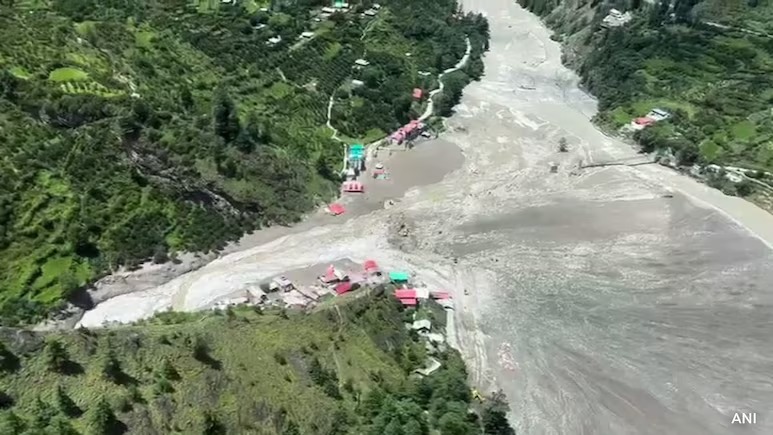
New Delhi: A detailed scientific investigation has revealed that the devastating flood that struck Dharali village in Uttarkashi in August 2025 was not caused by a cloudburst or a glacial lake outburst flood, as initially suspected. Scientists from the Indian Space Research Organisation have concluded that the disaster was triggered by the sudden collapse of a large exposed ice sheet high in the Himalayas.
Dharali is located along the Bhagirathi River, near the point where the glacier fed Khir Gad stream descends from the Srikanta Glacier. On August 5, 2025, a powerful surge of water, mud and rocks rushed through the village, destroying homes, hotels and markets along the narrow valley. Videos recorded by residents showed a sudden and violent wave of debris followed by slower muddy flows that continued for several hours.
Initially, the disaster was widely believed to be the result of either a cloudburst or a glacial lake outburst flood. However, scientists analysed rainfall records from the India Meteorological Department and found that rainfall in the area during the days leading up to the event had been only light to moderate. Satellite imagery also confirmed that there were no glacial lakes in the upper catchment that could have burst.
Further analysis using satellite data and digital elevation models traced the origin of the flood to a steep slope more than 5,200 metres above sea level, just below the glacier. The location contained a nivation zone, a hollow on a shaded mountain slope where snow and ice accumulate and survive for long periods even though the area is not a full glacier.
Satellite images taken in July 2025 showed that sections of ice in this zone had become exposed for the first time in at least 15 years as rising temperatures and glacier thinning removed the protective snow cover. This exposed ice eventually collapsed, releasing large volumes of ice, water and debris.
The collapsed mass rapidly accelerated down a steep slope and travelled more than 2,500 metres through the narrow Khir Gad valley. As it moved downhill, it gathered rocks, soil and loose material, transforming into a powerful debris flood before reaching Dharali.
Scientists warn that such ice patch collapses could become more frequent as Himalayan glaciers continue to shrink due to rising temperatures. They say improved satellite monitoring, including the use of radar satellites capable of seeing through clouds, could help identify unstable ice patches and provide early warning of similar hazards in the future.
Sorry, there was a YouTube error.