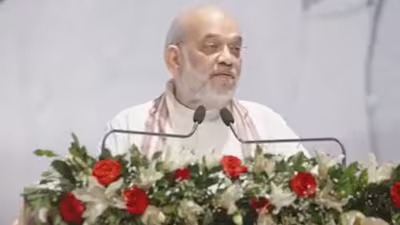
New Delhi: Union Home Minister Amit Shah, during his visit to West Bengal, launched a sharp political attack on the Trinamool Congress government while addressing a public programme in Barrackpore in North 24 Parganas. Speaking before party supporters and local residents, Shah accused Chief Minister Mamata Banerjee and her government of opposing the slogan “Vande Mataram” for political reasons, claiming it was being done to protect infiltrators.
Shah asserted that resistance to the slogan was not merely a political stance but an assault on Bengal’s heritage and the nation’s cultural identity. He questioned whether the people of the state would tolerate what he described as opposition to symbols deeply rooted in India’s freedom movement and national consciousness. According to him, rejecting “Vande Mataram” amounted to distancing Bengal from its historical and cultural legacy.
Highlighting the emotional and historical significance of the slogan, Shah recalled that many freedom fighters embraced “Vande Mataram” as their final words before laying down their lives for the country. He said the phrase was inseparable from India’s struggle for independence and carried the spirit of sacrifice and unity that defined that era.
The Home Minister also announced that the central government, under the leadership of Prime Minister Narendra Modi, has decided to commemorate 150 years of “Vande Mataram” across the country. He stated that the slogan would resonate nationwide, symbolising unity from Bengal to Kashmir, from Kanyakumari to Gujarat, and across every region of India.
Turning to electoral politics, Shah expressed strong confidence in the Bharatiya Janata Party’s prospects in West Bengal. He claimed that the BJP would secure more than 50 percent of the vote share in the upcoming Assembly elections and form the next government in the state. He positioned Bengal as the next political milestone for the party after Bihar, signalling an aggressive campaign strategy.
Concluding his address, Shah appealed directly to voters, urging them to reject what he described as politics that undermines national identity. He called on the people of Bengal to remove the Trinamool Congress government through the ballot, framing the election as a decisive moment to protect the state’s heritage, culture, and place within the broader national narrative.
Sorry, there was a YouTube error.