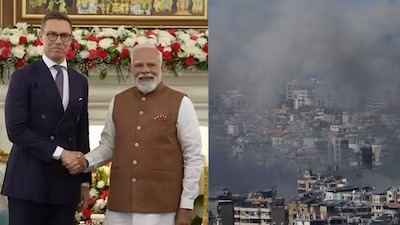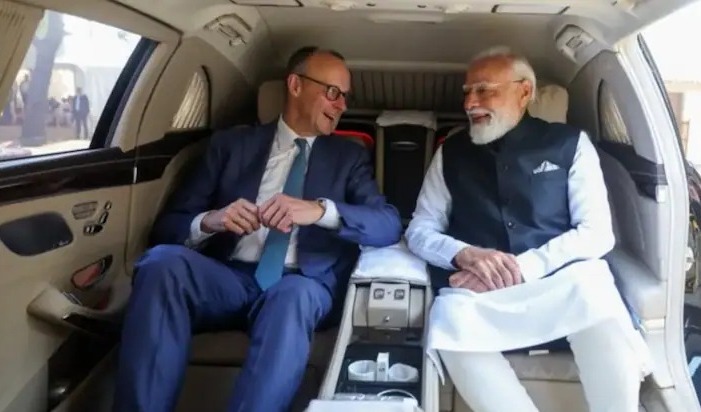
New Delhi: India and Germany on Monday announced a major step to strengthen people to people ties, with Berlin unveiling visa free transit for Indian passport holders passing through Germany. The move came as Prime Minister Narendra Modi and German Chancellor Friedrich Merz held wide ranging talks aimed at deepening cooperation across defence, trade, technology and education.
The two leaders pledged to expand bilateral engagement to jointly address challenges emerging from global geopolitical uncertainty. Their discussions concluded with the signing of 19 agreements, including a roadmap for defence industrial collaboration, a comprehensive partnership in higher education and an agreement to enhance cooperation in the telecommunications sector.
Both sides also called for the early conclusion of the India European Union free trade agreement, describing it as a key driver to expand trade volumes and unlock new economic opportunities. The visa free transit decision was highlighted as a measure that would further encourage mobility and strengthen ties between citizens of both countries.
Chancellor Merz arrived in Ahmedabad on a two day visit accompanied by a large business delegation, marking his first official trip to Asia since assuming office. Prime Minister Modi welcomed the German leader and said growing defence and security cooperation reflected a shared vision and strong mutual trust. He added that streamlined procedures in defence trade would pave the way for co development and co production between industries in both countries.
The leaders reaffirmed their commitment to a free and open Indo Pacific, respect for international law and cooperation under the UN Convention on the Law of the Sea. They also announced a new bilateral Indo Pacific consultation mechanism and reiterated strong support for the India Middle East Europe Economic Corridor, calling it transformational for global connectivity and commerce.
Economic engagement featured prominently, with Prime Minister Modi noting that bilateral trade has crossed the USD 50 billion mark, the highest ever. He said more than 2,000 German companies operating in India reflected long term confidence in the Indian economy. Both sides also agreed to build resilient and trusted supply chains, particularly in critical minerals and semiconductors.
Cooperation in climate action, clean energy and urban development was reinforced, with a joint green hydrogen project described as a future oriented milestone. The leaders also emphasised collaboration on skilling and mobility, especially in healthcare, as Germany seeks a growing number of skilled professionals from India.
On global issues, the two leaders exchanged views on Ukraine, Gaza and the need for reform of international institutions. They jointly condemned terrorism in all forms and committed to strengthening cooperation against terror networks, underscoring a shared determination to promote global peace and stability.
Sorry, there was a YouTube error.