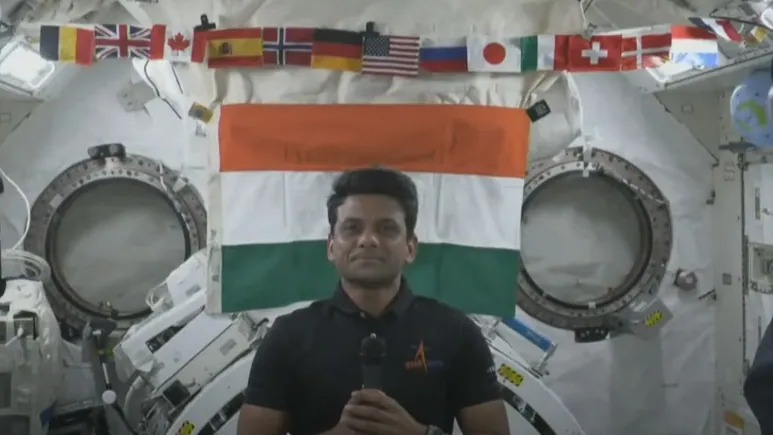
New Delhi: Curiosity met the cosmos when students from various schools in Lucknow had a once-in-a-lifetime interaction with astronaut Group Captain Shubhanshu Shukla, currently aboard the International Space Station (ISS). From floating in microgravity to eating Gajar ka Halwa in space, Shukla gave an engaging glimpse into the unique challenges and thrills of living in orbit.
Speaking to the students via a live link during a session organised under ISRO’s Vidyarthi Samvad Programme, Shukla — who made history as the first Indian to reach the ISS — answered questions with infectious enthusiasm. Hosted at City Montessori School, the session also featured Group Captain Angad Pratap, one of the astronaut-designates for India’s maiden human spaceflight mission, Gaganyaan.
Describing the launch of Axiom Mission 4 from the Kennedy Space Center in Florida on June 25 as “amazing and dynamic,” Shukla captivated the students with stories from space.
On sleeping in zero gravity, Shukla explained, “There’s no floor or ceiling in space. You might find someone sleeping on the wall, someone on the ceiling. It’s important we tie our sleeping bags securely, otherwise we might float to another part of the station and not be found in the same place in the morning!”
When asked about health emergencies, he assured that astronauts are well-prepared. “We carry adequate medical supplies for most situations, and there are strict health protocols in place.”
One of the highlights for students was hearing about food in space. Shukla revealed that while meals are pre-packaged, astronauts get to choose from a variety of options. “Food becomes one of the main sources of motivation. I’ve carried Gajar ka Halwa, Moong Dal Halwa, and Aam Ras to space,” he said, recalling his earlier interaction with Prime Minister Narendra Modi.
He also shared details about mental health in space, a growing area of focus for space agencies. “Being able to connect with family and friends using modern communication technology helps a lot,” he said, acknowledging the psychological demands of long-duration space travel.
On adjusting to microgravity, Shukla explained that the body undergoes several changes. “The absence of gravity is a major challenge. Initially, it takes time to adapt, but after a few days, the body adjusts. However, the real challenge will be on returning to Earth and reacclimating to gravity, which takes preparation and time.”
Discussing fitness routines aboard the ISS, he said, “In space, your muscles don’t get the same workout as they do on Earth. So, we have to exercise daily. We have a bicycle without a seat — we strap ourselves in and pedal. We also use machines for strength and cardio training.”
Students were especially fascinated when Shukla described the view from space. “One of the most beautiful things is to look out and see the Earth from above. It’s breathtaking — blue, peaceful, and fragile. It reminds us of how precious our planet is.”
Group Captain Angad Pratap, present at the event, encouraged students to stay focused and pursue careers in science and space. “The next couple of decades will open exciting possibilities in India’s space journey. Whether it’s becoming a researcher or an experimental test pilot in the armed forces, there are numerous avenues to explore,” he said.
Students described the event as “inspiring and eye-opening.” One said, “Group Captain Shubhanshu gave us a real sense of what space life is like — from food to floating to fitness.” Another added, “He showed us the possibilities that lie ahead if we stay committed to science.”
As the event concluded, one thing was clear: Shukla’s journey has not only broken new ground in Indian space history but has also ignited young minds back home with dreams of reaching for the stars.
Sorry, there was a YouTube error.