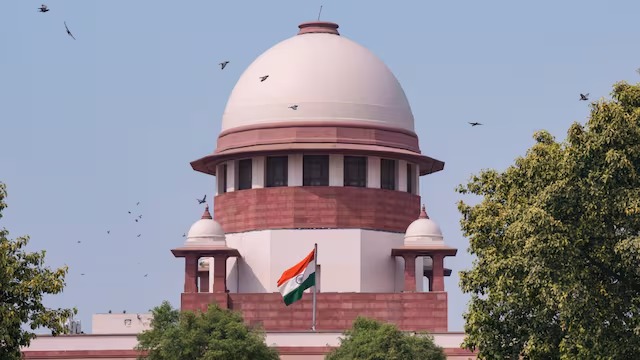
New Delhi Amid rising tensions between the judiciary and certain sections of the executive, the Supreme Court on Monday indirectly responded to recent critical remarks made by Vice President Jagdeep Dhankhar and several BJP leaders. The court noted that it has been accused of overstepping its role and encroaching upon the domains of Parliament and the executive.
The observation came during a hearing on a petition seeking the imposition of President’s Rule in West Bengal following incidents of political violence, including clashes in Murshidabad that reportedly led to several deaths and injuries.
‘Are We to Issue a Mandamus?’ – Justice Gavai
During the hearing, advocate Vishnu Shankar Jain brought up recent violent incidents in West Bengal, urging the court to consider invoking President’s Rule under Article 356 of the Constitution. However, Justice BR Gavai, who is in line to become the next Chief Justice of India, responded with caution.
“You want us to issue a mandamus? As it is, we are alleged to have encroached upon parliamentary and executive functions,” Justice Gavai remarked, subtly referencing the ongoing debate surrounding the judiciary’s role in governance.
Backdrop: Tamil Nadu Verdict and Executive Pushback
The Supreme Court’s comments come in the wake of strong criticism from Vice President Dhankhar over a recent SC verdict related to legislative procedure. In a landmark ruling, the court directed the President and Governors to act within a three-month window on Bills re-passed by legislatures.
Vice President Dhankhar expressed concern over the ruling last week, saying, “We never bargained for democracy on this day.” He questioned whether the judiciary was now acting as a “super-parliament,” suggesting that such rulings blur the separation of powers.
“There is a directive to the President by a recent judgment. What is happening in the country? We have to be extremely sensitive. Judges are now legislating, executing, and yet are not held accountable,” Dhankhar said.
BJP MP’s Remarks Add Fuel to the Fire
Further fueling the controversy, BJP MP Nishikant Dubey accused the Supreme Court of overreach, even suggesting that it was inciting religious unrest. “The Supreme Court is going beyond its limits… If one has to go to the Supreme Court for everything, then shut down Parliament and State Assemblies,” he stated.
These remarks were widely criticized, and the BJP leadership promptly distanced itself from Dubey’s comments, clarifying that his views did not reflect the party’s official stance.
Tensions Between Institutions Escalate
This exchange highlights a growing rift in the balance of power between the judiciary and other arms of the government. The Supreme Court, through its recent judgments, has emphasized accountability and time-bound governance. Meanwhile, the executive has raised concerns about judicial overreach and the potential undermining of democratic structures.
As India heads into a politically charged period, these institutional tensions are expected to remain at the center of national discourse.
Sorry, there was a YouTube error.