Team Goemkarponn
Panaji:
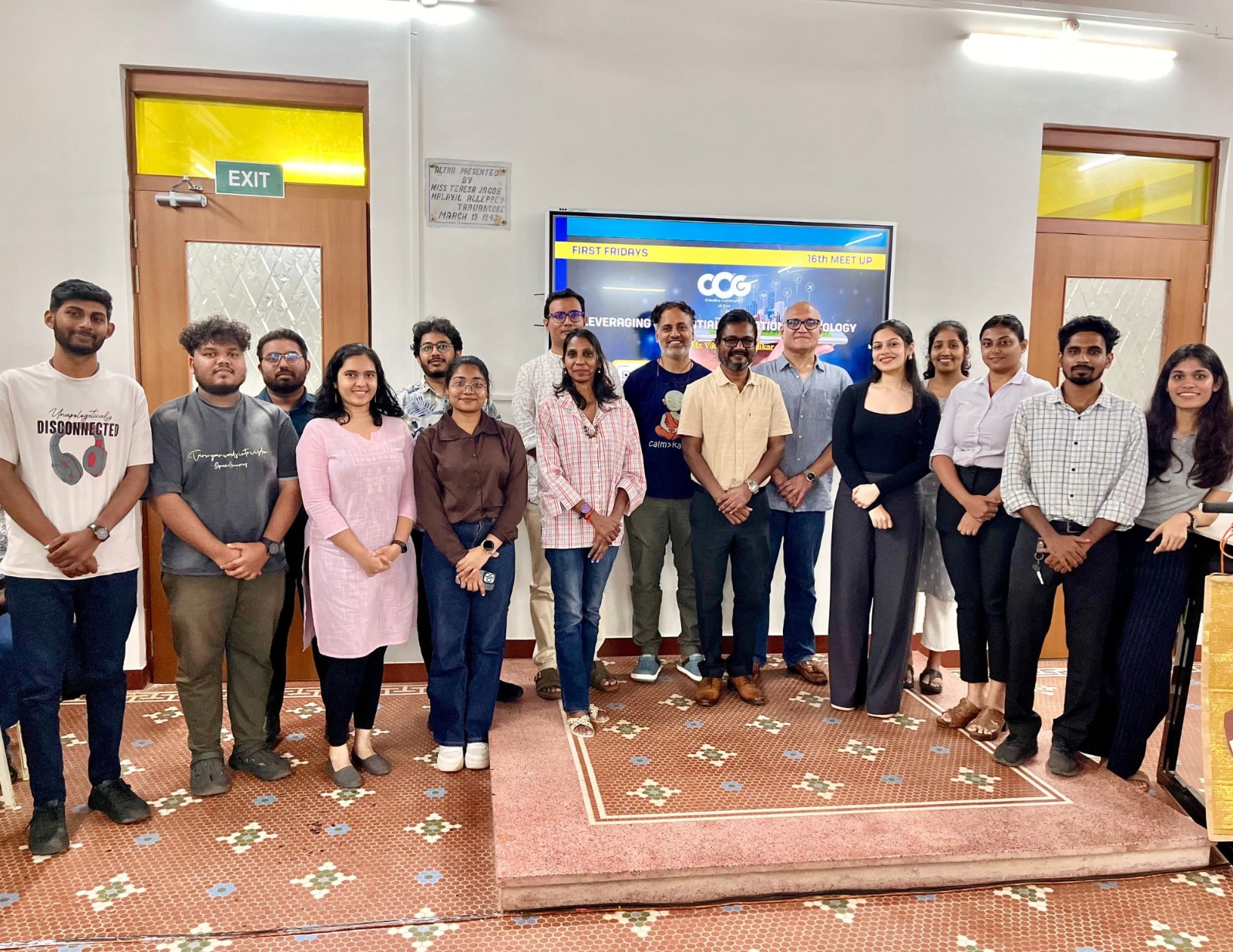
Margao, September 2025: From revolutionising businesses to shaping daily routines, geospatial and location technologies are changing how we interact with the world, starting with the simple question: ‘WHERE?’. The 16th edition of First Friday, a monthly meetup by Goa’s Creative Community, delved deep into how geospatial tools are becoming an indispensable part in today’s tech-driven world.
Held at FiiRE, a coworking centre in Margao, the session was organised by the Creative Community of Goa (CCG) in collaboration with the Association of Designers of India (ADI) – Goa Chapter, with support from the Startup & IT Promotion Cell, Department of Information Technology, Electronics and Communications (DITE&C), Government of Goa.
The insightful session was led by Architect and Entrepreneur Vikrant Karandikar who took the audience on a journey through the evolution of geospatial technology, from its military origins to its present-day role in powering everyday services like GPS, delivery tracking and healthcare diagnostics.
Emphasising the growing importance of this technology, Karandikar explained how location data has transcended physical geography to become a major force behind influencing smarter decisions and innovative business models, whether it’s finding the exact spot for a food delivery or marking an injury location during an MRI.
“Geospatial Technology is no longer limited to maps. Every business today is powered by location data,” said Karandikar as he explained how startups like CouchSurfing and Airbnb leveraged such technology to reduce cost, increase efficiency and provide more personalised services. He also pointed out how users have become collaborators in the geospatial ecosystem, sharing live feedback on apps like Swiggy, Google Maps and Amazon, where crowd-sourced reviews and real-time location updates are central to business operations.
Drawing a parallel from retail, Karandikar recalled how brands selling shampoos in urban metros had to repackage into Rs 2 and Rs 10 sachets, based on local purchasing power, an early example of location-aware product strategy.
On urban mobility, he highlighted the ACES model (Autonomous, Connected, Electric, Shared), citing Tesla’s ADAS, connected cars with e-SIMs and platforms like Uber and Ola that made owning a car optional in cities like Mumbai.
On the conservation front, Karandikar spoke about drones tracking rhino habitats in Karnataka and the use of 3D mapping for heritage sites, preserving India’s cultural fabric through spatial documentation. He even touched on sports technology, where smart bats with embedded gyroscopes now analyse swing dynamics and give real-time performance feedback.
The event gave the audience a glimpse into what they may be overlooking in their day-to-day routines and the hidden role of location in everything, be it building design using GIS tools (e.g. AutoCAD with relational data), optimising logistics with precise route mapping and disaster response through geospatial alerts like flood or cyclone warnings via SMS.
The session offered a valuable opportunity to reimagine how space, information and technology are deeply connected, much like how location-based services have reshaped the strategies of tech giants like Apple, Microsoft and Google.
Addressing the gathering of creative professionals, Shri DS Prashant, CEO of Startup and IT Promotion Cell, highlighted how Goa is not just remaining a beach destination but is evolving into a hub for premium tech innovation.
“Goa is where talent comes together to build products, because it nourishes creativity and offers ample space and freedom one needs to innovate,” he remarked, urging creators to come together and shape Goa into India’s Creative Capital.
As Goa’s creative ecosystem continues to blend design, technology and innovation, events like First Friday are becoming powerful hubs for inspiration, offering a unique space to learn, network and ignite ideas to build a better future.