Team Goemkarponn
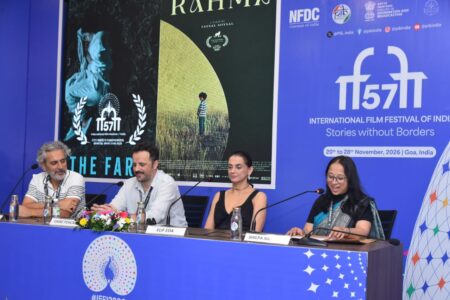
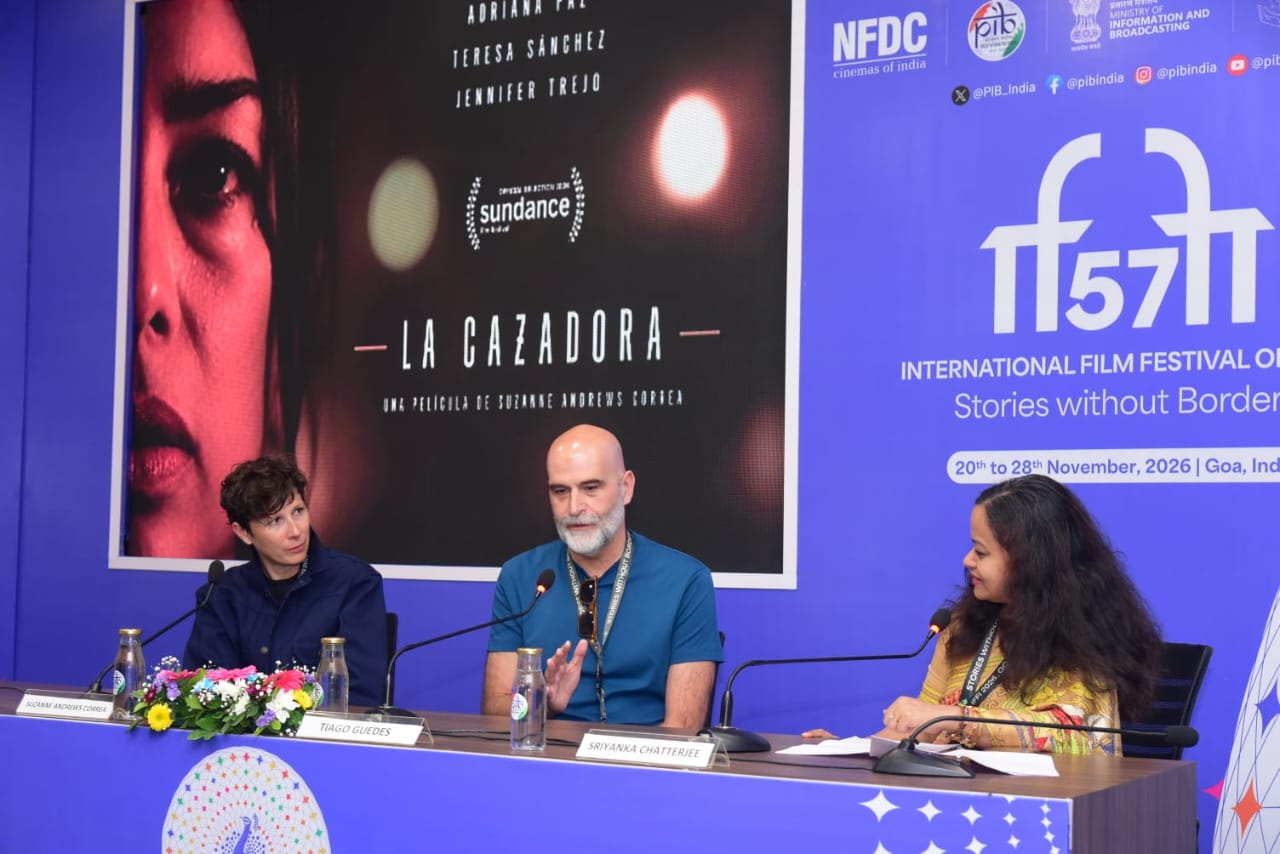
PANAJI: Two contrasting films exploring the complexities of human relationships, emotions and the pursuit of justice took centre stage at the 57th International Film Festival of India (IFFI) in Goa, as filmmakers Tiago Guedes and Suzanne Andrews Correa shared insights into their respective films, *Aquí* and *The Huntress (La Cazadora)*.
Addressing the media during the festival, the directors highlighted how cinema can connect audiences across cultures and geographical boundaries by placing human emotions at the centre of storytelling.
While *Aquí* is a dystopian drama screening in the International Competition section, *The Huntress* is a Spanish-language thriller inspired by real-life violence against women in Ciudad Juárez, Mexico.
Directed by Tiago Guedes, *Aquí* is adapted from J. M. Coetzee’s Jesus trilogy and presents a dystopian society where people begin their lives without memories of the past, while conformity and social control shape their existence.
The film follows Simón, who takes in a young boy named David. Believing that the child needs a mother, Simón approaches Inés, and the three gradually form an unconventional family.
However, David’s refusal to conform to society’s expectations challenges the established order. Through his imagination and desire for freedom, he questions the world around him.
Speaking about the film, Guedes said his primary interest was to explore what it means to be human and raise philosophical questions for audiences.
He explained that while adapting Coetzee’s works, he focused more on the emotions evoked by the books than on the plot itself, allowing the essence of the original work to translate into a visual experience.
The director also explored the idea that family is not necessarily defined by blood relations but by choices and deeply human experiences.
The film deliberately retains silences and ambiguity, allowing viewers to develop their own interpretations. Its title, which means ‘Here’ in Spanish and Portuguese, reflects its central ideas.
The second film, *The Huntress (La Cazadora)*, marks the feature-film debut of Mexican-American filmmaker Suzanne Andrews Correa.
Starring Adriana Paz, the Spanish-language drama thriller follows a factory worker and survivor of sexual assault in Ciudad Juárez who turns to vigilante justice after repeated attempts to seek help fail.
Inspired by real-life violence against women and the 2013 case of an unidentified vigilante known as ‘Diana, Hunter of the Bus Drivers’, the film examines the experiences of women facing sexual violence and exploitation in the Mexico-Texas border region.
The story unfolds over 24 hours, following the protagonist’s struggle, desperation and pursuit of justice.
Correa said she wanted audiences to experience the protagonist’s sense of powerlessness and understand the circumstances that drive her towards revenge when the system fails to respond to her pleas for help.
She described the film as a call for justice and social change against the continuing violence faced by women.
Recalling the decade-long journey of making the film, Correa emphasised that filmmaking requires persistence, dedication and the ability to remain committed to a story.
She said she was deeply moved to see the protagonist’s emotions resonate with international audiences, even among viewers unfamiliar with the real-life circumstances that inspired the narrative.
The press interaction, moderated by Sriyanka Chatterjee, highlighted the power of cinema to communicate universal emotions through stories rooted in distinct cultural and social realities.
Although *Aquí* unfolds in an imagined dystopian world and *The Huntress* is set against the realities of violence in a Mexican border city, both films explore fundamental questions about human relationships, family, freedom and justice.