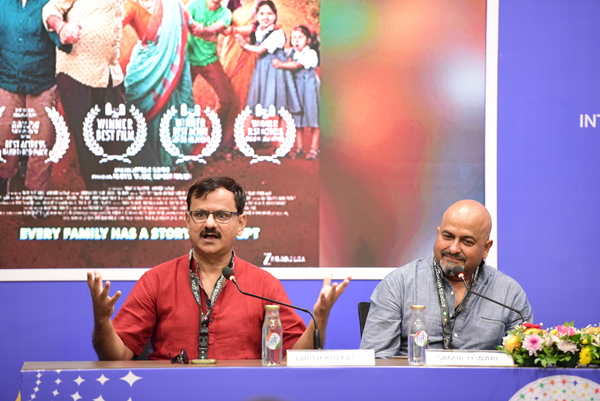
Team Goemkarponn
PANAJI: The Marathi comedy-drama *Baapya*, set in coastal Maharashtra, explores gender identity, family relationships and social acceptance through an intimate story of personal choices and changing societal perceptions, said director and producer Samir Tewari at the 57th International Film Festival of India (IFFI) in Goa.
The film, featured in the Mainstream Cinema section of Indian Panorama, was discussed during a press conference organised by the Press Information Bureau (PIB) on November 25, attended by Tewari and actor Girish Kulkarni.
Explaining the central idea behind the film, Tewari said it was not intended to preach or offer lessons to society but to tell a story about acceptance, understanding and relationships.
He described the film as the journey of an individual who wants to become who they are, while seeking acceptance from the people around them.
Tewari said he chose Marathi as the language of the film because he wanted to create an honest cinematic work rooted in a genuine script rather than developing a project around a particular actor.
Recalling the challenges during production, he said securing financial backing was difficult, as potential investors considered the subject risky despite appreciating the script.
Casting the lead character, Baapya, was another challenge, with several actresses hesitant to portray a character whose gender identity differed from their own. He credited actress Rajashri Deshpande for accepting the role and approaching it as a demanding creative challenge.
Reflecting on changing social attitudes, Tewari observed that conventional distinctions between men and women were gradually becoming less rigid. He emphasised that individual choices concerning clothing, behaviour and identity should not become reasons for judgement or discrimination.
Actor Girish Kulkarni highlighted the importance of treating every individual with dignity and without prejudice. Drawing an analogy with nature, he said people accept the diversity of trees and plants without judging their forms, and the same spirit should guide human relationships.
Kulkarni described cinema and other art forms as both mirrors of contemporary society and instruments that can guide social progress.
He said *Baapya* attempts to reinterpret traditions in the context of changing times without abandoning cultural roots, adding that acceptance and love form the underlying spirit of the film.
He further observed that embracing differences in language, clothing and identity reflects India’s strength in unity in diversity.
Highlighting the importance of IFFI as a platform for cultural and intellectual exchange, Kulkarni said the festival brings together filmmakers and audiences from India and abroad, encouraging engagement with diverse cinematic perspectives.
The press conference was moderated by Supriya Ghaytadak.