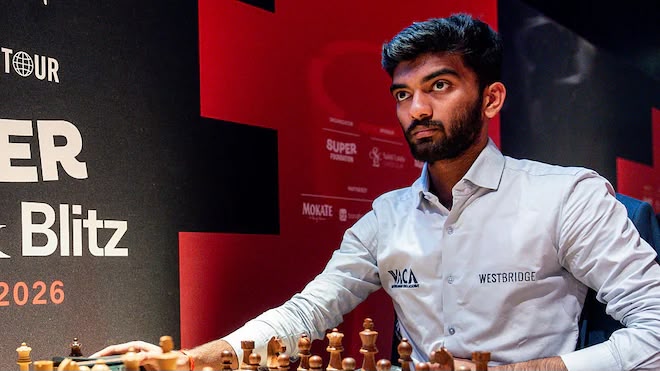
New Delhi: Defending champion D Gukesh began his World Chess Championship title defence with a hard-fought draw against Uzbekistan’s Javokhir Sindarov in the opening game on Tuesday. The Indian grandmaster showed remarkable composure under severe time pressure to withstand his opponent’s challenge and avoid an early setback.
Playing with the black pieces, Gukesh opted for the Berlin Defence against Sindarov’s Ruy Lopez opening, an unexpected choice that introduced an interesting tactical battle from the beginning.
The Indian initially appeared slightly cautious and came under pressure as Sindarov developed a marginal positional advantage through better piece placement and pawn structure. The Uzbek challenger attempted to increase the pressure during the queenless middlegame, but Gukesh responded with accurate calculations and maintained his position.
Sindarov later sacrificed a pawn to create complications and make the game more unpredictable. However, despite having limited time on the clock, Gukesh found the necessary moves to neutralise the threat.
For a brief period, the Indian even appeared capable of gaining the upper hand. Sindarov, however, prevented the position from slipping away and managed to secure a repetition of moves.
Interestingly, the same position was repeated five times before both players agreed to a draw. Under chess rules, a threefold repetition is sufficient for a player to claim a draw.
The opening result provides Gukesh with a steady start as attention now shifts to the second game, where he will have the advantage of playing with the white pieces.
The championship consists of 14 classical games, with the first player to reach 7.5 points declared the winner. If the scores remain level after 14 games, shorter-format tie-breaks will determine the champion.
The total prize pool stands at USD 2.5 million. Each victory earns USD 200,000, while the remaining prize money is divided equally between the two players. In the event of a tie-break, the winner receives USD 1.3 million and the runner-up takes home USD 1.2 million.