New Delhi: India has reiterated its support for the safe, speedy and sustainable return of displaced Rohingya refugees to Myanmar, a day after the International Court of Justice (ICJ) ruled that Myanmar committed genocide against the community during the 2017 military operations in Rakhine State.
India said it had taken note of the landmark judgment and maintained that the return of displaced Rohingya people to their homeland remained an important priority.
The government highlighted its humanitarian assistance to Rohingya refugees living in camps in Bangladesh under Operation Insaniyat. India had provided relief supplies in five separate consignments and also supported the Rakhine State Development Programme in Myanmar to improve conditions for the displaced population.
The ICJ, the United Nations’ highest judicial body, delivered its verdict on Thursday, finding that Myanmar had violated its obligations under the Genocide Convention through its actions against the Rohingya community in northern Rakhine State during the 2017 clearance operations.
The court also directed Myanmar to facilitate the return of tens of thousands of people who fled the violence. The case was initiated by The Gambia in November 2019 over alleged violations of the Genocide Convention.
The judgment was delivered by a 9-6 majority. More than one million Rohingya refugees are currently living in Bangladesh after fleeing persecution and military operations in Myanmar.
Bangladesh welcomed the ruling, describing it as an important development in the pursuit of justice and efforts to resolve the prolonged refugee crisis.
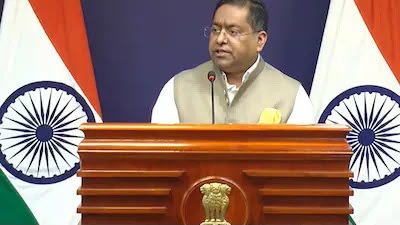
During the same briefing, India also addressed questions on recent international developments, including a meeting involving the leaders of Russia, China and the United States in Shenzhen. New Delhi said it had taken note of the meeting and would assess its significance after receiving details of its concrete outcomes.
On the Quad Summit held in Manila, India highlighted cooperation in artificial intelligence, emerging technologies, maritime surveillance, cybersecurity, regional cable connectivity and security. It also pointed to plans for a Quad Business Leaders Forum next year.
India said further details on the question of the Quad’s chairmanship would be provided separately.
The government also rejected allegations made by the US Commission on International Religious Freedom, questioning the organisation’s credibility and describing its approach as politically biased.