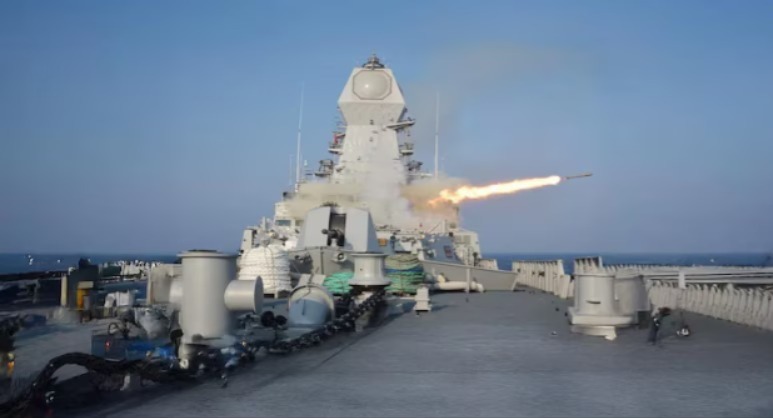
New Delhi: In a significant boost to the Indian Navy’s anti-submarine warfare capabilities, India has successfully conducted user trials of its indigenously developed Extended Range Anti-Submarine Rocket (ERASR) system.
The trials were carried out from warship INS Kavaratti between June 23 and July 7, marking a major milestone in India’s defence self-reliance journey.
Defence Minister Rajnath Singh congratulated the Defence Research and Development Organisation (DRDO), the Indian Navy, and the domestic industry partners involved in the system’s development and testing. In a post on X (formerly Twitter), his office said, “The successful induction of this system will boost the striking power of the Indian Navy.”
Developed entirely within India, the ERASR system is a next-generation anti-submarine weapon designed to engage underwater threats with precision. The Indian Navy highlighted that the system features a twin-rocket motor configuration, allowing it to cover a wide range of distances with high accuracy and consistency.
During the evaluation phase, a total of 17 ERASRs were test-fired at various ranges. The trials successfully validated all key performance parameters, including range capability, electronic time fuse functioning, and warhead effectiveness.
The successful development and trial of the ERASR marks another step forward in India’s mission to strengthen its indigenous defence capabilities under the ‘Aatmanirbhar Bharat’ initiative. Once inducted, the system is expected to significantly enhance the Navy’s ability to counter sub-surface threats and protect India’s maritime interests.
Sorry, there was a YouTube error.