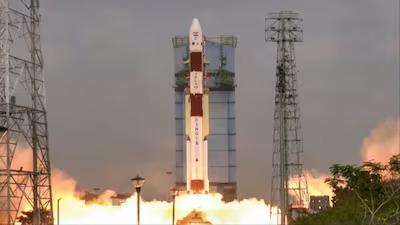
New Delhi: India’s Polar Satellite Launch Vehicle faced another setback on Monday after an anomaly was detected during the third stage of its 64th mission, PSLV C62, raising fresh concerns for the Indian space programme. The rocket lifted off from the Satish Dhawan Space Centre in Sriharikota at 10:18 am, carrying the EOS N1 earth observation satellite along with multiple co passenger satellites.
According to ISRO, the initial phase of the launch unfolded as planned. The first and second stages of the four stage launch vehicle performed nominally, and the mission progressed smoothly during the early minutes after liftoff. However, a deviation was observed during the third stage, affecting the rocket’s trajectory and preventing the mission from continuing along its intended flight path.
ISRO Chairman Dr V Narayanan stated that the mission could not proceed as expected and that detailed data analysis is currently underway. He refrained from declaring the launch either a success or a failure, adding that further clarity would be provided once the evaluation is complete. Historically, deviations in the third stage of the PSLV have often resulted in near total mission failure.
PSLV C62 was particularly significant as it was meant to mark the rocket’s return to flight after its previous mission in 2025 also ended unsuccessfully. That earlier failure had similarly occurred during the third stage. Although a failure analysis committee was constituted at the time, its findings were not made public. Despite this, PSLV C62 was cleared as the first PSLV launch of 2026.
The mission was carrying 15 satellites in total. These included EOS N1, a DRDO developed surveillance satellite named Anvesha, and several commercial satellites. Most were intended to be placed in a sun synchronous orbit, while one satellite was planned for a controlled re entry.
If confirmed as a failure, this would mark the fifth unsuccessful mission in the PSLV’s 64 flight history. While the overall record remains strong, consecutive setbacks pose challenges for ISRO’s operational confidence and commercial commitments. The impact extends to foreign customers and Indian space startups, including Hyderabad based Dhruva Space, which had seven satellites onboard.
The PSLV remains central to India’s commercial launch ambitions and future industry led missions. The final outcome of PSLV C62 is expected to carry important implications for both ISRO and the growing private space ecosystem that relies on the vehicle’s proven reliability.
Sorry, there was a YouTube error.