SRINAGAR: In a bold and dramatic act of defiance, former Jammu and Kashmir Chief Minister Omar Abdullah scaled the wall of the historic Martyrs’ Graveyard (Mazar-e-Shuhada) in Srinagar on Monday morning after being barred by authorities from participating in the traditional July 13 commemorations. The move came a day after the administration, led by the Lieutenant Governor, denied permission for the Martyrs’ Day observance and placed several political leaders under house arrest.
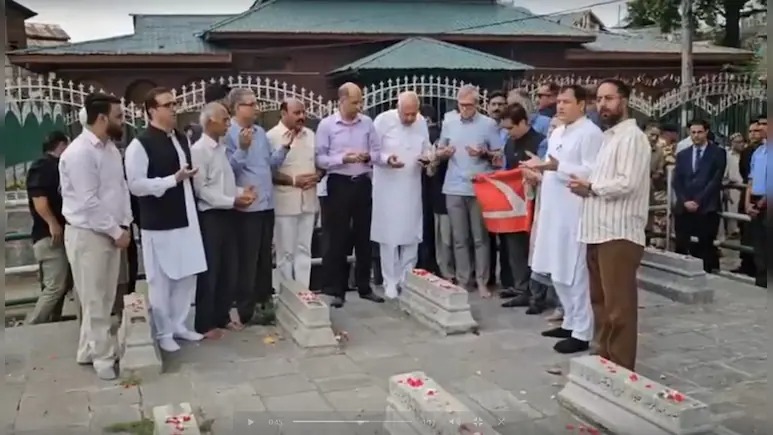
Accompanied by other National Conference leaders, Abdullah drove to the graveyard, resisted attempts by police to stop him, climbed over a locked gate, and offered fatiha (prayers) to the 22 Kashmiris shot dead on July 13, 1931, by the Dogra Maharaja Hari Singh’s forces during a protest in front of Srinagar jail.
“Yesterday, we were denied permission, locked in our homes, and kept from reading fatiha for our martyrs,” Abdullah told the media. “Today, I didn’t inform anyone. I got in my car and drove to Nowhatta Chowk. They tried to stop us again, set up bunkers, and even manhandled us. What law gives them this right?” he asked, slamming the conduct of the police and accusing them of acting under political pressure from New Delhi.
Calling the security forces’ actions “shameful,” Abdullah said, “We are not their slaves. We are the people’s representatives. We came here, paid our respects, and no one could stop us.”
On July 13, political leaders across party lines were prevented from visiting the graveyard, which is adjacent to the revered Naqshband Sahib shrine. Omar Abdullah returned to Srinagar from Delhi on Sunday evening only to find himself, once again, under what he described as “house arrest.”
Quoting late BJP leader Arun Jaitley, Abdullah posted on X, “Democracy in J&K is a tyranny of the unelected. Unelected nominees of New Delhi locked up the elected representatives of the people of J&K.”
The administration had refused to grant permission for the annual Martyrs’ Day event and issued a warning against public gatherings near the graveyard. A formal request by the National Conference to reinstate the public holiday for July 13 was also rejected.
Several leaders condemned the restrictions. PDP chief and former Chief Minister Mehbooba Mufti said, “The ‘dil ki doori’ PM Modi talks about will only end the day you accept our heroes as your own, just as Kashmiris have embraced national icons like Mahatma Gandhi and Bhagat Singh.”
She added, “When you lay siege to the Martyrs’ Graveyard and lock people in their homes, it reveals your discomfort with our history. The martyrs of July 13 stood against tyranny, just like countless others across India. Their sacrifices will not be forgotten.”
Jammu and Kashmir People’s Conference chief Sajad Lone also claimed he was placed under house arrest. “I don’t understand why the Union government is so determined to redefine what is sacred to the people of Kashmir. These sacrifices are etched in our collective memory,” he wrote on X.
July 13 is a seminal date in Kashmir’s political history. On this day in 1931, a crowd gathered outside the Srinagar jail in support of Abdul Qadeer, who had called on the people to rise against Dogra rule. In response, the Dogra forces opened fire, killing 22 protesters. The killings sparked widespread agitation and eventually forced the Maharaja to consider political reforms, including holding Assembly elections—laying the foundation for democratic governance in Jammu and Kashmir.
Until 2019, Martyrs’ Day was a state-recognized holiday. Police personnel would perform ceremonial gun salutes, and political parties held tributes and gatherings. However, after the abrogation of Article 370 and the bifurcation of Jammu and Kashmir into Union Territories, the administration stopped official commemorations.
In 2020, the government also removed July 13 and December 5 (Sheikh Abdullah’s birthday) from the list of public holidays. Meanwhile, September 23, the birthday of Maharaja Hari Singh, was declared a public holiday—signaling a controversial shift in the official historical narrative.
Despite the clampdown, Omar Abdullah and other leaders insist they will continue to honour the memory of Kashmir’s martyrs. “We may be denied access to their graves, but we will never forget their sacrifice,” Abdullah said.
The administration’s decision to restrict commemorations has reignited a heated debate over memory, identity, and democratic rights in a region long accustomed to political conflict and historical erasure.
Sorry, there was a YouTube error.