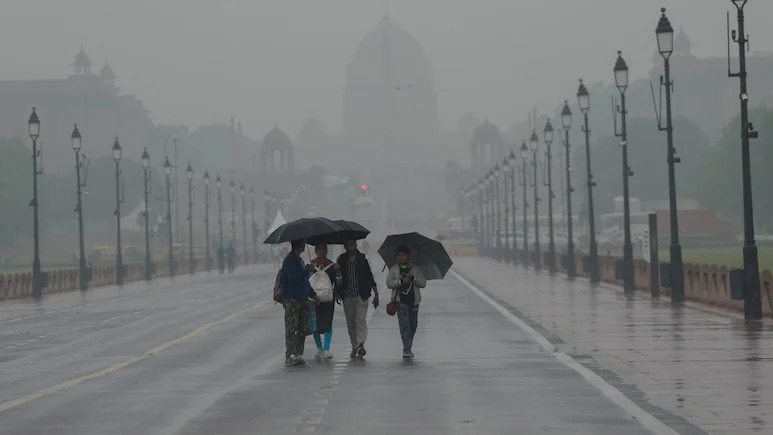
New Delhi: An unusual weather system stretching nearly 1,000 kilometres is currently bringing intense rainfall, thunderstorms and strong winds across parts of India, Pakistan and Afghanistan, creating conditions rarely seen at this time of year.
The weather event is linked to an active Western Disturbance that has formed an unusually straight band of low pressure extending from Afghanistan through Pakistan and deep into northern and central India. This long rain band is generating widespread storms accompanied by gusty winds ranging between 40 and 80 kilometres per hour, along with isolated hailstorms and light to moderate rainfall or snowfall in several regions.
Typically, western disturbances originate from low pressure systems over the Mediterranean region and move in curved paths toward the Himalayas, mainly during the winter months. In contrast, the current system has formed as a straight trough pattern, highlighting increasingly unpredictable weather patterns.
The disturbance is associated with an upper air cyclonic circulation over northern Pakistan and is influencing weather across northwest India. Several areas have already experienced significant impacts. Heavy to very heavy rainfall has been reported in the sub Himalayan regions of West Bengal and Sikkim, while southern states such as Karnataka, Andhra Pradesh, Kerala and Tamil Nadu have received heavy showers. Hailstorms have also been recorded in multiple areas.
The system is further strengthened by interactions with several lower level cyclonic circulations across different parts of the country, including north Madhya Pradesh, east Uttar Pradesh, west Rajasthan, Haryana, northeast Assam and coastal Andhra Pradesh.
The current disturbance is expected to continue affecting the Western Himalayan region and adjoining plains for the next day before gradually weakening. However, meteorologists have indicated that another weaker western disturbance may approach the region around March 22.
Moisture fueling this system originates from evaporation over several water bodies, including the Mediterranean Sea, Caspian Sea, Black Sea and the Persian Gulf. As the system moves eastward, additional moisture from the Arabian Sea strengthens the weather activity.
In the Delhi NCR region, light to moderate rain accompanied by thunderstorms and winds of 30 to 50 kilometres per hour is expected until Friday. Daytime temperatures are likely to remain between 25 and 28 degrees Celsius, noticeably lower than usual for late March.
Historically, strong western disturbances are most common between December and February. By late March, such systems become rare as atmospheric patterns shift northward, making this extended weather event particularly unusual.