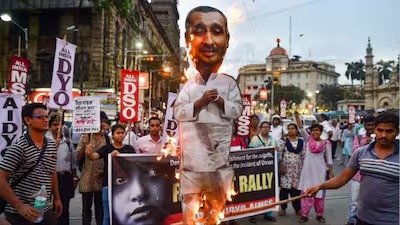
New Delhi: The Supreme Court on Monday stayed a Delhi High Court order that had suspended the life sentence of expelled BJP MLA Kuldeep Singh Sengar in the Unnao rape case, ruling that the issue raises important questions of law that require detailed examination. The apex court directed that Sengar shall not be released pursuant to the High Court’s December 23 order.
A three judge bench led by Chief Justice of India Surya Kant, along with Justices JK Maheshwari and Augustine George Masih, was hearing a petition challenging the suspension of sentence. The bench observed that the interpretation of who qualifies as a public servant under the POCSO Act needs careful consideration, especially in cases involving persons in positions of power.
During the hearing, the court was told that Sengar had been convicted for rape and aggravated penetrative sexual assault, offences that involved abuse of authority over a minor. It was argued that holding a dominant position at the time of the offence is a critical factor in determining the gravity of the crime. The bench expressed concern over a possible interpretation that could classify lower ranking officials as public servants while excluding elected representatives.
The Chief Justice remarked that the judiciary must ensure consistency and fairness in applying the law, stressing that the conviction itself had been delivered by the courts after due process. The bench cautioned against attempts to influence legal proceedings outside the courtroom and reaffirmed that judicial remedies remain accessible at all times.
The court also noted that amendments enhancing punishment under child protection laws were intended to strengthen safeguards and not to create new offences. At the same time, it acknowledged arguments raised on behalf of the accused regarding statutory interpretation and the limits of importing definitions across different laws.
Justice Maheshwari pointed out that the High Court order did not specifically address provisions dealing with offences committed by public servants. While recognising the general principle that suspension of release orders is uncommon once granted, the bench said the peculiar facts of this case warranted an exception.
Accordingly, the Supreme Court stayed the operation of the High Court order and directed that notices be issued, with counter affidavits to be filed within four weeks.
The Delhi High Court had earlier suspended Sengar’s life sentence, citing the period of imprisonment already undergone and imposing conditions including a personal bond and restrictions on contact with the survivor. However, Sengar continues to remain in jail due to a separate conviction in the custodial death of the survivor’s father. Appeals in both matters remain pending.
Sorry, there was a YouTube error.