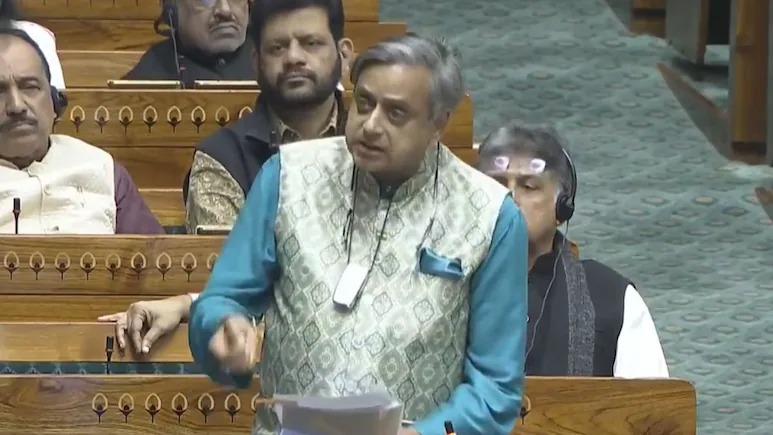
New Delhi: Congress MP Shashi Tharoor strongly opposed the government’s move to replace the Mahatma Gandhi National Rural Employment Guarantee Act (MGNREGA) with the newly proposed Viksit Bharat Guarantee for Rozgar and Ajeevika (G RAM G) during a Lok Sabha debate on Tuesday. Tharoor described the renaming as “immoral” and urged the government not to “sully Ram’s name,” emphasizing the symbolic importance of retaining Gandhi’s legacy in the rural employment scheme.
Tharoor, who has occasionally drawn criticism within his party for his favorable remarks about Prime Minister Narendra Modi, argued that replacing Gandhi’s name disregards the alignment between Gandhi’s vision for self-sufficient villages and the concept of Ram Rajya, a period of idealized governance. “Let us not dishonour his legacy by creating a division where none existed,” he said, reinforcing his stance on X.
Priyanka Gandhi Vadra also criticized the G RAM G bill, calling for its withdrawal and highlighting the unnecessary costs and administrative burdens involved in renaming longstanding schemes. She urged that the bill be referred to a standing committee and reminded lawmakers that MGNREGA has successfully supported rural economies for 20 years. Responding to a “family” remark from the treasury benches, she added, “Mahatma Gandhi is not from my family, but he is like my family… the entire country feels the same way.”
The G RAM G bill introduces significant changes to the funding structure of the rural employment scheme. Under MGNREGA, the central government covers 100 percent of wages for unskilled workers, while states contribute a smaller share of expenses. The new bill requires states to bear 40 percent of the total costs, raising concerns among opposition leaders and even some allies of the ruling party, such as Andhra Pradesh’s Telugu Desam Party. For northeastern and Himalayan states, the cost-sharing ratio will be 90:10, while union territories will continue to receive full central funding. The total proposed expenditure is estimated at Rs 1.51 lakh crore annually, with the central government contributing Rs 95,692 crore.
Government sources maintain that the G RAM G bill aligns with the broader “Viksit Bharat 2047” vision and shifts the scheme to a normative funding model, consistent with other central programs. However, opposition leaders continue to question both the renaming and the increased financial burden on states.
Sorry, there was a YouTube error.