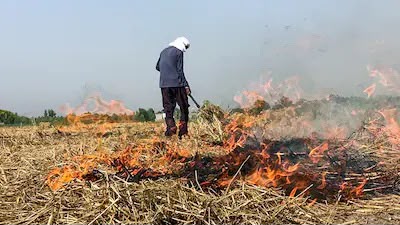
New Delhi: The political battle over Delhi’s rising air pollution has intensified, with the BJP-led Haryana government defending its efforts to prevent stubble burning after Punjab questioned why the state was not facing similar scrutiny.
The latest confrontation began after Punjab Finance Minister Harpal Singh Cheema questioned the BJP’s repeated criticism of Punjab over Delhi’s pollution. He asked why Punjab was being singled out when Haryana, another major agricultural state, was also reporting farm fires.
In response, Haryana has highlighted its incentive-based crop residue management strategy, presenting it as a model that combines financial assistance, machinery, monitoring and strict enforcement.
Under the Parali Protsahan Yojana, Haryana provides farmers with an incentive of Rs 1,200 per acre for effective crop residue management. The state has also appointed 8,134 village-level nodal officers to monitor farm fires and coordinate with farmers.
Its strategy includes deploying thousands of agricultural machines, establishing district and block-level Parali Protection Forces, drone surveillance and night patrolling. Collected paddy straw is also being directed towards industries, biomass power plants and compressed biogas facilities.
Farmers found burning stubble can face FIRs, challans, environmental compensation and red entries in their land records.
Meanwhile, Punjab has defended its performance by highlighting a decline in farm fires over the past two years. According to state pollution control board data, Punjab recorded 3,144 farm fire incidents between September 15 and November 6, 2026. Tarn Taran reported the highest number at 611, followed by Ferozepur with 410.
The AAP government has pointed to the deployment of more than 21,000 crop residue management machines and expenditure exceeding Rs 800 crore on stubble management.
The political exchange has also involved allegations over the handling of farm fires, with AAP rejecting claims that government officials were facilitating stubble burning.
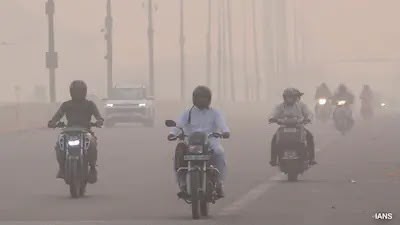
The controversy comes as Delhi continues to battle poor air quality. The Centre informed the Supreme Court that stubble burning contributed around 14 per cent of the city’s pollution on the day under consideration. The court also highlighted vehicular emissions and called for stronger crop residue collection mechanisms.
With the 2027 Punjab Assembly elections approaching, the growing confrontation has added political pressure on the Mann government to demonstrate progress in controlling stubble burning.