By Suraj Nandrekar
PANAJI: Government records and successive Economic Survey reports list several development and welfare initiatives at Colvale Central Jail, including a biogas plant, sewage treatment plant, water harvesting system, solar power installations, video conferencing facilities, and rehabilitation-oriented units. However, the present status and actual utilisation of several of these projects raise questions that merit a project-wise public disclosure by the authorities.
The issue is not merely whether a project was announced or sanctioned. The more important question is whether it was completed, commissioned, maintained and is still delivering the intended benefit.
The Economic Survey reports have recorded initiatives related to prisoner rehabilitation, education, skill development and other facilities at the central jail. The 2024-25 Economic Survey, for instance, records that a spice grinding machine was provided through CSR funding and operated by women prisoners. It also refers to a sanitary pad manufacturing machine.
But government documentation of a project does not by itself establish its continuing success. The present operational status, production, utilisation and maintenance records need to be established.
Biogas plant
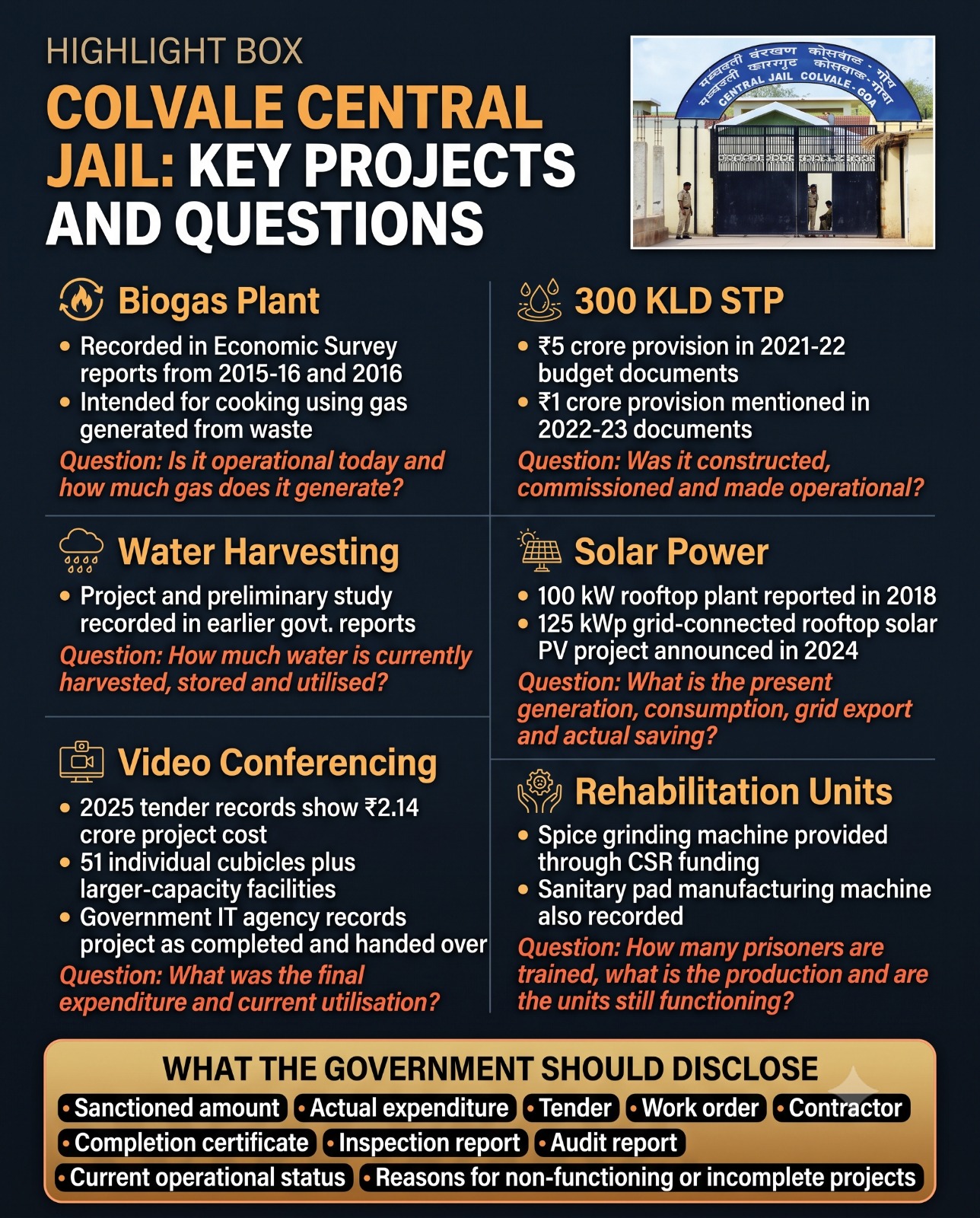
One of the older initiatives is the biogas plant. The 2015-16 Economic Survey recorded that a biogas plant had been installed at the jail, with the gas generated from waste intended for cooking. The 2016 report also referred to a biogas plant in the kitchen block.
The key questions now are whether the plant remains operational, how much biogas it currently generates, who maintains it and how extensively it has been used in recent years.
₹5 crore provision for 300 KLD STP
Another significant project is the proposed 300 KLD sewage treatment plant.
Budget documents provided for the design, construction, supply, installation, testing and commissioning of a 300 KLD STP at the Colvale Central Jail. The 2021-22 explanatory memorandum showed a budget provision of ₹5 crore, while the 2022-23 documents again referred to the 300 KLD STP, with a provision of ₹1 crore.
The crucial question is whether the project was actually constructed and commissioned.
If it was completed, the authorities need to disclose its location, operational capacity, daily treatment levels and maintenance arrangements. If it was sanctioned but not completed, the reasons for the delay or non-completion also need to be placed in the public domain.
Water harvesting
Water conservation has also featured in government records concerning the jail. Earlier Economic Survey reports referred to the initiation of a water harvesting project, including preliminary inspection and preparation of a draft report.
Subsequent reports included water harvesting and conservation among welfare-related initiatives.
But the present system requires verification. How much water is being harvested? What is its storage capacity? How much is actually being utilised? What was the expenditure on the infrastructure?
These are basic performance indicators for any public project.
Solar power
Solar power is another area where the records show both earlier and newer initiatives.
In 2018, reports indicated that a 100 kW rooftop solar plant had been installed at the jail and was being prepared for grid connectivity. In 2024, the government announced a new 125 kWp grid-connected rooftop solar PV plant along with solar street lighting.
The status of both installations needs to be clarified. The authorities should disclose installed capacity, actual generation, internal consumption, power exported to the grid and the savings achieved.
Video conferencing facility
The video conferencing project raises a separate set of questions concerning expenditure and utilisation.
While some claims have put the project cost at around ₹4 crore, the available 2025 tender records show a quoted project cost of ₹2.14 crore for video conferencing cubicles on the first and second floors of the Chakkar Block. The tender included interior work, furniture, electrical works and a DG set.
According to information from the Goa government’s Info Tech Corporation, the project has been completed, commissioned and handed over for use. It includes 51 individual video conferencing cubicles along with other larger-capacity cubicles.
Therefore, the issue here is not whether the project exists. The questions are about the final expenditure, payments made after the tender, technical and construction approvals and, importantly, how extensively the facility is currently being used.
Rehabilitation beyond the prison walls
Rehabilitation is another important measure of the jail’s functioning. The objective of a correctional institution cannot be restricted to custody and security. Skill development and reintegration are equally important.
The 2024-25 Economic Survey records the provision of a spice grinding machine through CSR funding, operated by women prisoners. It also refers to a sanitary pad manufacturing machine.
The authorities should disclose the number of prisoners trained, production achieved, revenue generated, present condition of the machines and whether the units remain operational.
The larger question
The questions surrounding Colvale Central Jail therefore go beyond any single project.
The government should make project-wise information available, including the sanctioned amount, actual expenditure, administrative and technical sanctions, tender and work-order details, contractor names, completion certificates, inspection reports, audit reports and current operational status.
Where a project is no longer operational or remains incomplete, the reasons and responsibility should also be clearly recorded.
This is not about declaring a project successful or unsuccessful without evidence. It is about establishing whether public money has translated into functioning public infrastructure.
Colvale Central Jail is usually discussed in terms of security, drugs, inspections and issues concerning prisoners. But a government institution of this scale must also be examined through the infrastructure and public expenditure devoted to it.
The real test of any government project does not come on the day it is announced. It comes after the cameras leave, when the facility has to function every day.
For Colvale Central Jail, the next step should therefore be an independent performance audit and project-wise public disclosure.
The documents have recorded the projects. The government now needs to disclose what happened to them on the ground.