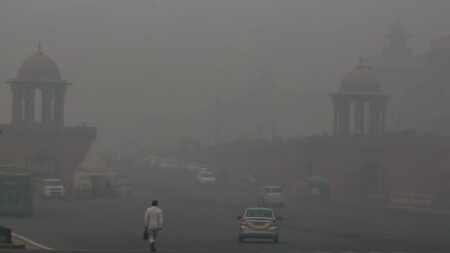
New Delhi: India’s worsening air pollution crisis is not just an environmental concern but a major public health and economic emergency, with annual losses estimated at $95 billion, according to a report by the Federation of Indian Chambers of Commerce and Industry (FICCI).
The report, titled Clean Air, Healthy India, highlights the devastating impact of toxic air on human health, life expectancy and economic productivity. It warns that India can no longer afford to treat air pollution as a seasonal problem and calls for urgent action across government departments and industries.
The findings reveal that more than two million deaths in India in 2023 were linked to air pollution. Exposure to polluted air is estimated to reduce the average life expectancy of Indians by approximately 3.5 years. More than 660 million people live in areas where fine particulate pollution exceeds national safety standards.
Air pollution is also placing an enormous burden on the economy. The report estimates that around 1.3 billion working days are lost every year due to pollution-related health problems. Productivity can decline by 8 to 10 per cent during periods of severe pollution, while the overall economic losses could reach $95 billion annually, equivalent to approximately 3 per cent of India’s GDP.
The report explains that pollution cannot be controlled through city-level measures alone. In Delhi, local sources account for only around 36 per cent of PM2.5 pollution during winter and 26 per cent during summer. A significant share originates outside the city’s boundaries, highlighting the need for coordinated action across entire regions.
The health consequences extend beyond respiratory illnesses. Exposure to PM2.5 particles, which can enter the bloodstream, is associated with heart attacks, strokes, neurological disorders, cognitive decline, pregnancy complications and premature ageing. Children, elderly people, outdoor workers and economically weaker communities remain particularly vulnerable.
FICCI has recommended a comprehensive approach involving stronger pollution monitoring, stricter emission controls, cleaner industrial technologies, dust management at construction sites, improved traffic systems and alternatives to crop residue burning.
The report also calls for greater emphasis on reducing PM2.5 levels rather than relying heavily on PM10 measurements under existing clean air programmes.
Its central message is that India already has several policies to address pollution, but weak implementation and coordination continue to limit their effectiveness. FICCI has urged governments, industries and healthcare institutions to make clean air a year-round public health priority.