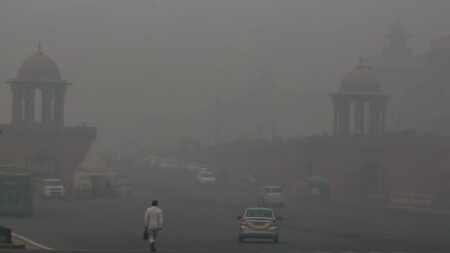
New Delhi: Delhi could witness artificial rain on Wednesday as severe air pollution continues to affect the national capital, with the Air Quality Index (AQI) recorded at 308, placing it in the ‘very poor’ category.
An attempt to induce artificial rainfall may be made if suitable clouds are spotted over the city. An aircraft equipped with cloud seeding technology is currently ready at IIT Kanpur and can reach Delhi within approximately an hour. Another aircraft is also on standby in the capital.
The operation will depend on cloud height, atmospheric moisture and weather conditions. Experts will assess the availability of sufficient moisture before deciding whether to proceed with the experiment.
With no immediate rainfall expected in Delhi, cloud seeding is being considered as an alternative measure to temporarily reduce pollution levels.
How Does Cloud Seeding Work?
Cloud seeding is a weather modification technique in which substances such as silver iodide and dry ice are introduced into suitable clouds to encourage precipitation. The process can be carried out using specially equipped aircraft, rockets or ground-based equipment.
Artificial rainfall can help settle airborne dust and pollutants, potentially providing temporary relief from deteriorating air quality. However, experts caution that the method cannot address the underlying causes of pollution and should not be considered a long-term solution.
Previous Cloud Seeding Experiments in Delhi
The Delhi government has previously explored artificial rainfall in collaboration with IIT Kanpur as an emergency measure during periods of severe pollution.
On November 5, reports indicated that two rounds of cloud seeding trials had been conducted near the Indira Gandhi International Airport over the preceding 15 days. These trials involved operations at approximately 30,000 metres.
The initiative was first introduced through a memorandum of understanding between the Delhi government and IIT Kanpur last year. However, earlier experiments conducted in October 2025 failed to produce rainfall.
The assessment attributed the unsuccessful attempts to insufficient moisture in the clouds, highlighting the importance of favourable atmospheric conditions for successful cloud seeding.