Team Goemkarponn
PANAJI: Goa University is set to strengthen its academic, research and technological capabilities with infrastructure projects worth approximately ₹28.55 crore, inaugurated by Chief Minister Dr. Pramod Sawant on Tuesday.
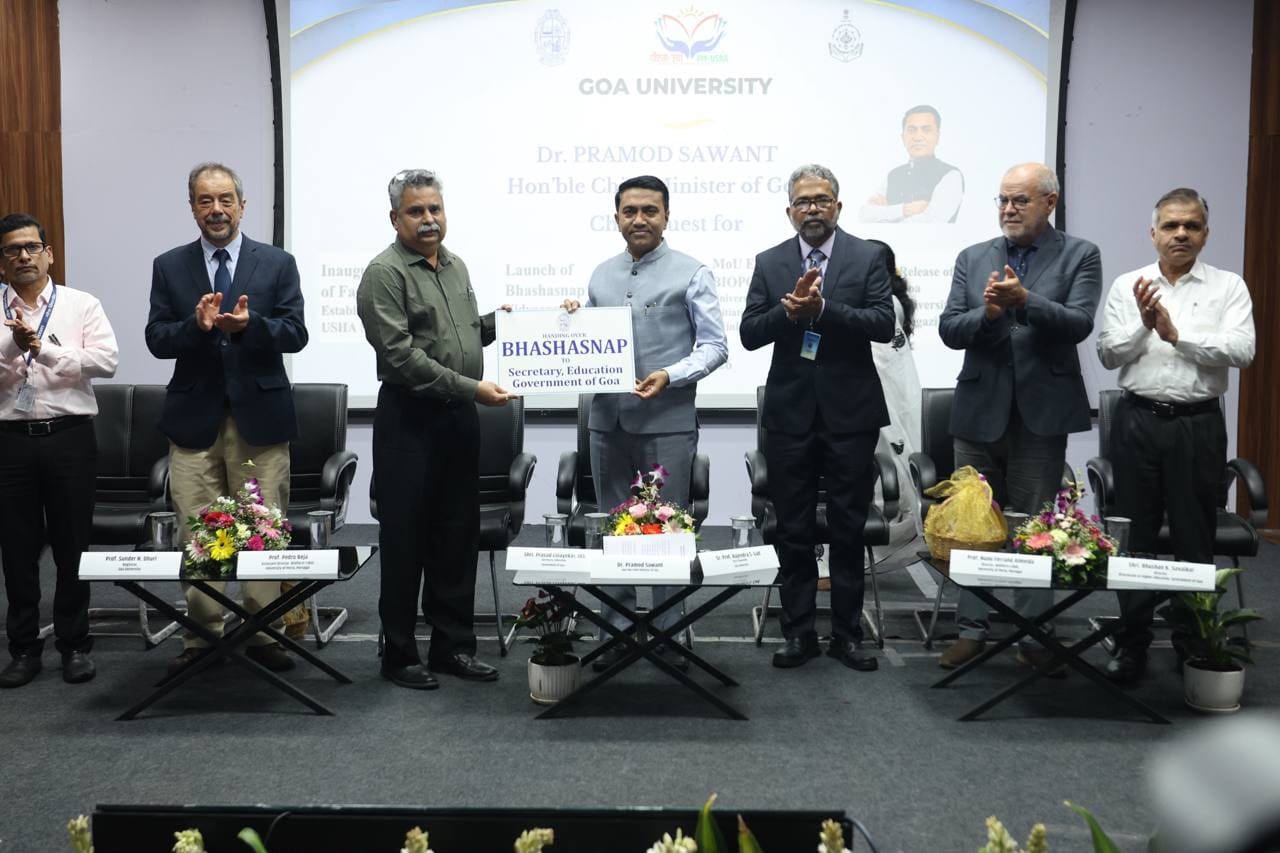
The programme marked the inauguration of several major academic and research facilities, the launch of the BhashaSnap web application and the signing of a Memorandum of Understanding (MoU) with BIOPOLIS-CIBIO, University of Porto, Portugal, to initiate the Indo-Portugal TwinLab Partnership. The university’s e-magazine was also released on the occasion.
Among the major facilities inaugurated were the new Computer Science and Technology building at Goa Business School and several advanced facilities at the University Materials Characterisation Laboratory in Block E.
These include the Robotics and Internet of Things (IoT) Lab, Machine Learning Lab, Liquid Nitrogen Facility, 2D GC and TOF Mass Spectrometer, and SQUID Magnetometer.
The Chief Minister also inaugurated two electric buses with seating capacities of 14 and 23 passengers, aimed at improving transportation facilities on the university campus.
The infrastructure projects have been developed at an investment of approximately ₹28.55 crore under the PM-USHA/RUSA 2.0 scheme. Certificates under the scheme were also presented to the principals of five participating institutions.
Speaking on the occasion, Dr. Sawant said the newly launched BhashaSnap application would enable students in Goa to access bilingual learning content in their preferred languages, including Konkani.
He highlighted that the web application supports translation into all 22 Scheduled Languages of India and comes with an automatic source-language detection feature, making educational content more accessible to students.
Emphasising the importance of international scientific collaboration, the Chief Minister said the Indo-Portugal TwinLab Partnership would help address emerging environmental challenges through joint research, scientific exchange and capacity building.
Referring to Goa’s rich biodiversity, including the Western Ghats, forests, rivers, estuaries, mangroves, wetlands and marine ecosystems, he stressed the need for scientific research and international cooperation to tackle climate change, habitat degradation and pollution.
He expressed confidence that the partnership between Goa University and BIOPOLIS-CIBIO would strengthen biodiversity documentation, conservation efforts, ecosystem monitoring and environmental sustainability while creating new opportunities for young researchers.
The initiative is also expected to further strengthen the longstanding academic and cultural ties between Goa and Portugal.