Team Goemkarponn
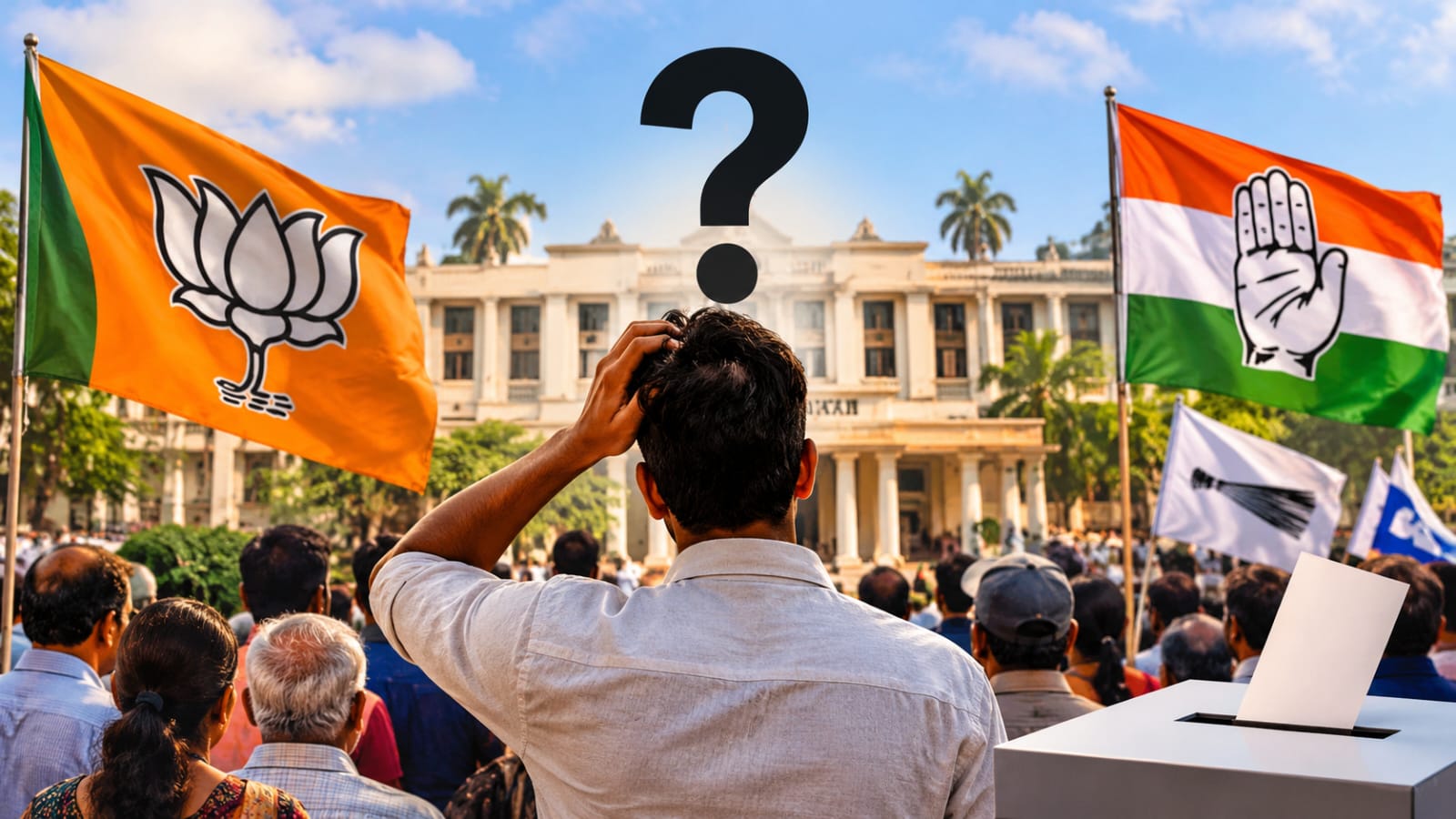
PANAJI: The political message emerging from Goa ahead of the 2027 Assembly elections is increasingly complicated: there is a growing appetite for change, but little clarity on who should bring it.
The latest survey captures this contradiction, pointing to mounting dissatisfaction with the BJP-led government while simultaneously exposing the Opposition’s inability to emerge as a convincing alternative.
Nearly two-thirds of respondents favour a change of government, while 56.4 per cent have expressed dissatisfaction with the ruling dispensation. Yet, the BJP-MGP alliance continues to command the support of 34.3 per cent of respondents, making it the single most preferred political formation.
The findings suggest that the BJP is facing the consequences of prolonged incumbency, but the Opposition has not yet succeeded in turning public discontent into a decisive political advantage.
The survey projects 16-18 seats for the BJP-MGP alliance and 14-15 for a Congress-led alliance, indicating that the next Assembly election could produce another closely contested verdict. A substantial undecided vote further complicates the picture.
The government’s performance assessment reveals the scale of the challenge facing the ruling alliance. While 43.6 per cent rated its performance positively, 56.4 per cent gave it a negative rating.
The BJP’s prolonged stay in power appears to be weighing on public sentiment. The survey’s analysis attributes the growing discontent partly to the government having completed three consecutive terms.
However, dissatisfaction with the government does not automatically translate into support for the Congress or any other Opposition party.
The preference figures underline this difficulty. While 22.8 per cent favoured a non-BJP alliance without defectors, a Congress-led alliance received 12 per cent support. Congress contesting independently secured 11.8 per cent.
The numbers point to an Opposition electorate that is yet to settle on a common political platform.
Perhaps the most revealing aspect of the survey is the disconnect between the demand for political change and the leadership capable of representing that demand.
Chief Minister Pramod Sawant received 33.5 per cent support in one leadership assessment, making him the most prominent individual political face in the survey. However, when respondents were asked who should become the next Chief Minister, 41.5 per cent preferred a leader from a non-BJP alliance.
Sawant secured 24.1 per cent in that assessment.
This suggests that while a section of voters may want a change in government, the Opposition has yet to convert that sentiment into support for a particular leader.
For the Congress and its potential allies, the challenge is therefore twofold: unite politically and establish a credible leadership proposition before the electorate.
The discontent also appears rooted in the everyday experience of dealing with the government.
Difficulty accessing government offices emerged as the biggest concern, cited by 77.5 per cent of respondents. Rising prices and concerns relating to water, identity and demography each figured at 75 per cent.
The survey also offers an uncomfortable insight into how voters perceive their elected representatives. As many as 95 per cent expect their MLA to help get their work done in government offices, while only 7.4 per cent expect legislators to raise local issues in the Assembly.
This reflects the importance voters attach to accessibility, personal intervention and the ability to navigate the administration.
Welfare schemes, meanwhile, remain an important consideration, with 56.5 per cent saying these benefits could be a reason to re-elect the government. But welfare support alone may not erase dissatisfaction over the functioning of the administration.
The constituency projections provide another warning for the ruling alliance. Fifteen constituencies have been classified as unsafe, 10 fall in the 50-50 category and only eight are considered safe.
Of the BJP’s 28 seats, just seven have been classified as safe, indicating that several sitting legislators could face difficult electoral battles.
The survey also projects a sharp decline in the electoral fortunes of the AAP and the Revolutionary Goans Party, suggesting that smaller political formations may struggle to repeat their previous performances.
For the BJP, the immediate concern is whether prolonged incumbency and dissatisfaction among sections of its traditional support base will translate into electoral losses.
For the Opposition, the greater challenge is proving that it can offer more than a collective rejection of the ruling party.
Goa’s 2027 election, therefore, may not simply be a referendum on the BJP’s performance. It could become a test of whether the Opposition can turn a growing demand for change into a coherent political alternative.
The BJP may be fighting anti-incumbency, but the Opposition is still fighting for credibility.