New Delhi: India’s first bullet train service is expected to begin operations in 2027, with the Surat-Vapi section of the Mumbai-Ahmedabad high-speed rail corridor scheduled to become operational first. The remaining stretches connecting the corridor to Mumbai will be opened in phases.
Railway Minister Ashwini Vaishnaw announced the timeline, highlighting the progress made on the ambitious infrastructure project. As of September, construction teams had completed 456 kilometres of pier work and 371 kilometres of viaduct construction.
Around six lakh noise barriers have been installed along a 299-kilometre stretch, while 9,300 overhead electrification masts have been erected across 206 kilometres of viaduct. Excavation work has also been completed for four mountain tunnels, while five kilometres of the 21-kilometre Maharashtra tunnel have been excavated using the mountain tunnelling method.
Civil construction has been completed at eight stations, with architectural finishing work currently underway. Development activities are also progressing at the three rolling stock depots located in Sabarmati, Surat and Thane.
One of the project’s biggest engineering challenges is India’s first undersea rail tunnel. The 21-kilometre tunnel in Maharashtra includes a seven-kilometre section passing beneath Thane Creek. Two tunnel boring machines, launched in July 2026 from Vikhroli and Sawli, are being used for the excavation. Each machine has a 13.6-metre cutterhead, weighs more than 3,000 tonnes and measures 96 metres in length.
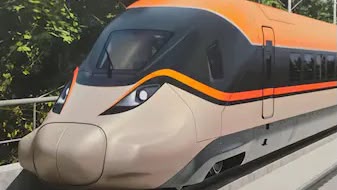
Meanwhile, manufacturing of India’s first indigenous bullet train sets is progressing. Integral Coach Factory and BEML are developing the B28 trainset, designed to operate at speeds of up to 280 kmph. Its first body frame has been completed and is undergoing structural testing, with track trials expected by mid-2027. A faster B35 trainset, designed for 350 kmph, is planned as the next development.
The project, initially announced in 2017, faced delays due to land acquisition and permission issues in Maharashtra, followed by the COVID-19 pandemic. Full-scale construction gained momentum in 2021.
The Mumbai-Ahmedabad corridor is expected to significantly reduce travel time between the two major cities while introducing a new era of high-speed rail transportation in India.